If other agents sell your product, at some point one of them forwards your quotation to their client with your logo on it. Sometimes that is fine. Usually it is the end of that relationship, because you have just introduced their client to you.
White labelling is the fix, and it is more than a logo swap. Here is what has to change, and what has to stay locked.
What the document has to carry
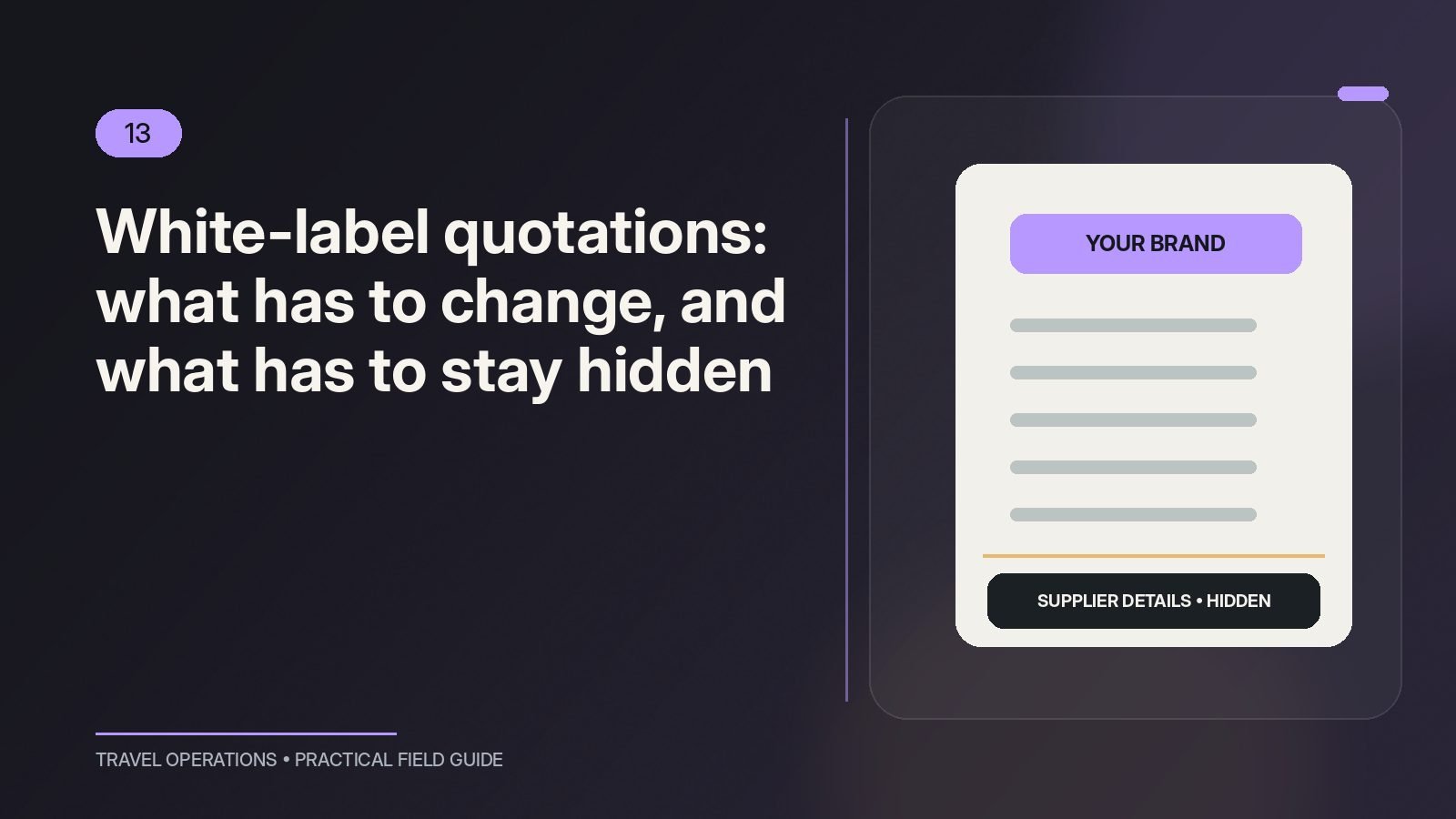
- Their brand, everywhere. Logo, colours, company name, address, contact details and the letterhead itself — including the footer, which is where an unbranded PDF usually gives itself away.
- Their terms and their bank details. This is the one that causes real damage. A payment schedule with your account number on a document sent by an agent is either a lost booking or a very awkward phone call.
- No trace of the platform. No "powered by" line, no filename that names the software, no share link on a domain that identifies you.
What has to stay hidden
The mirror of the branding question, and the more important one. An agent working on your rates must see their selling price and their own margin, and must never see your net cost. If both numbers exist on one screen, one of them will eventually reach a client — as a screenshot, a forwarded PDF, or a browser back button.
The way to check this in any system is to ask for an agent login and look at the screens yourself. Do not accept a description of what agents see. Log in as one.
Markup, and who sets it
Three arrangements, and they need different software behaviour.
- You set a net rate; the agent adds their own margin. The agent needs a markup field and needs to see the result, not the input.
- You set the selling price; the agent earns a commission. The agent needs the sell price and their commission, and nothing else.
- Both, by product. Common in practice and the reason a single global setting is not enough.
Markup, GST and the lines your client sees covers how these land on the client's copy.
The rate question underneath all of it
White labelling is presentation. What actually determines whether a B2B channel is worth running is whether every agent is quoting from your current rates or from a copy they took in March. If they hold copies, you are not running a channel — you are running a mailing list, and the price your client is quoted is one you last agreed to two seasons ago.
This is why the branding and the rate source are the same conversation. An agent portal that brands the document beautifully and lets each agent keep a private price list has solved the smaller half of the problem.
Where it goes wrong quietly
- Email. The document is branded and the covering email is not, because it goes from your mail server. Check what the agent's client actually receives, envelope included.
- The share link. A live link is better than an attachment, and it is also a page on somebody's domain with somebody's favicon. Check both.
- The enquiry form. A branded quotation with a button that sends the enquiry to you rather than to the agent is the most direct way there is to lose an agent.
Each of these is invisible from your own screen and obvious from theirs, which is the whole lesson: test the B2B channel by being the agent, not by being told about them.
Stop rebuilding the same quotation.
One rate card, one branded document, sent in minutes instead of an afternoon.
See what it does