Written 12 September 2026, and describing the rules as they stood that week. Both halves of this have moved twice in eighteen months — the accommodation slabs changed on 22 September 2025 and the collection rate on overseas packages changed on 1 April 2026 — so treat any figure below as something to confirm rather than something to copy. Your accountant signs the invoice, not a blog post.
Two different taxes land on the same quotation and they behave nothing alike. One is tax on your service and it is your cost of doing business. The other is not your money at all — you collect it, hand it over, and the traveller claims it back. Operators who blend the two into a single "all inclusive" figure are the ones who end up arguing about it in October.
GST on the package: two routes, and the cheaper one is not obvious
A tour operator supplying a package under heading 9985 has a choice.
- 5% on the gross package, with no input tax credit. The gross figure — accommodation, transport, the lot. You cannot recover the GST your hotels and suppliers charged you. The one carve-out is credit on tour operator services bought from another tour operator, which is what makes a B2B chain workable.
- 18% on the package, with input tax credit. You recover the GST on your inputs.
5% looks obviously cheaper and frequently is not. The question is how much embedded GST you are writing off. An operator whose costs are mostly hotel nights is forgoing credit on a large number; one whose costs are mostly a fleet they own is forgoing very little. Work it out on a real itinerary rather than accepting the default, and remember that credit on inputs in states where you are not registered is credit you cannot use anyway, which is the practical reason most operators land on 5%.
There is a third structure worth knowing about: acting as a pure agent, charging 18% on your commission only and passing the supplier costs through at actuals. It suits a business that books on behalf of a client rather than assembling a package, and it changes what your document has to show — the supplier's bill becomes part of it.
What changed on the hotel side, and why your costing moved
Accommodation was re-slabbed with effect from 22 September 2025. A room at a value of supply up to ₹7,500 per unit per day attracts 5% without input tax credit; at ₹7,500 or above it is 18% with credit. Before that date the sub-₹7,500 band was 12% with credit.
Two consequences for a quotation, and neither is theoretical.
- The threshold is per room per night, on the value of supply. A category upgrade that takes a room from ₹7,200 to ₹7,800 does not move the rate a little — it moves it from 5% to 18%. That is a step, not a slope, and it sits exactly where a "premium" option usually sits.
- On the 5% route, budget rooms now carry tax nobody recovers. The hotel cannot claim credit and neither can you. It is in your cost, so it belongs in your rate card rather than being discovered at the margin.
This is the practical argument for keeping tax-inclusive and tax-exclusive rates distinguishable in whatever holds your rates. See reading a hotel rate sheet.
Inbound and outbound: both are Indian supplies
The instinct is that a tour outside India, or a tour paid for in dollars, sits outside GST. Neither does.
- Inbound. A foreign tourist touring India is a supply performed in India, so the place of supply is India. Billing in foreign exchange does not make it an export.
- Outbound sold to an Indian resident. Both you and your client are in India, so the place of supply is India whatever the itinerary says. Not an export either.
The outbound position has been argued more than once, and an operator with real volume there should get their own opinion rather than a general one. What is not in dispute is that "the trip is abroad, therefore no GST" is not the rule.
TCS on overseas packages: 2%, from the first rupee
This is the change most catalogues have not caught up with. From 1 April 2026, under the table in Section 394(1) of the Income-tax Act 2025 — the provision that was Section 206C(1G) of the 1961 Act — tax collected at source on an overseas tour programme package is a flat 2%, and the threshold was removed. It applies from the first rupee.
What that replaced: 5% up to a threshold and 20% above it. If your quotation template still carries a 20% line, or still asks whether the client has crossed a limit this financial year, it is quoting a rule that no longer exists — and quoting 20% where 2% applies is a lost booking rather than a compliance problem.
What counts as a package, which is narrower than people think
An overseas tour programme package needs two or more components — an international travel ticket, hotel accommodation, boarding or lodging, or expenditure of a similar nature. A ticket on its own is not a package. A hotel booking on its own is not a package. Sell the ticket and the hotel together and it is.
Worth knowing in both directions: it tells you when you must collect, and it tells you why an enquiry that looks identical to another one is treated differently.
TCS is not a cost, and saying so is half the conversation
The 2% is not revenue and it is not a charge. It goes against the traveller's PAN, appears in their tax statement, and is set off against their tax for the year — refunded if they have overpaid. A client who understands that stops treating it as a price increase, and the sentence that gets you there is short: this is your tax, paid in advance, in your name.
It is still real cash you have to move, and the mechanics are yours.
- Collect when you receive payment, not when the trip departs. A part payment carries its own collection.
- Deposit by the 7th of the month following collection.
- File the quarterly statement and give the buyer their certificate. Both forms were renumbered under the 2025 Act, so check the current numbers with whoever files them — the obligation has not changed, the stationery has.
- Interest runs monthly — and a part month counts as a whole one — for failing to collect and again, at a higher rate, for collecting and not depositing.
- No PAN means a higher rate. The long-standing rule is twice the rate or 5%, whichever is greater, which at 2% means 5%. Collect the PAN at booking; chasing it afterwards is how a 2% line becomes a 5% argument.
The client who wires their own money
A traveller who books their own hotels and remits under the Liberalised Remittance Scheme is in a different provision with different numbers: a ₹10 lakh threshold, 2% above it for education and medical purposes, and 20% for other purposes. Their bank collects it, not you.
Somebody will eventually ask you to unbundle a package so that they can remit directly. That is their decision to make and it is worth being straight about the trade: they lose a single point of responsibility for the trip, and they are not escaping tax — they are moving which provision they sit in, and for a leisure trip the other one is 20%.
How all of this should look on the document
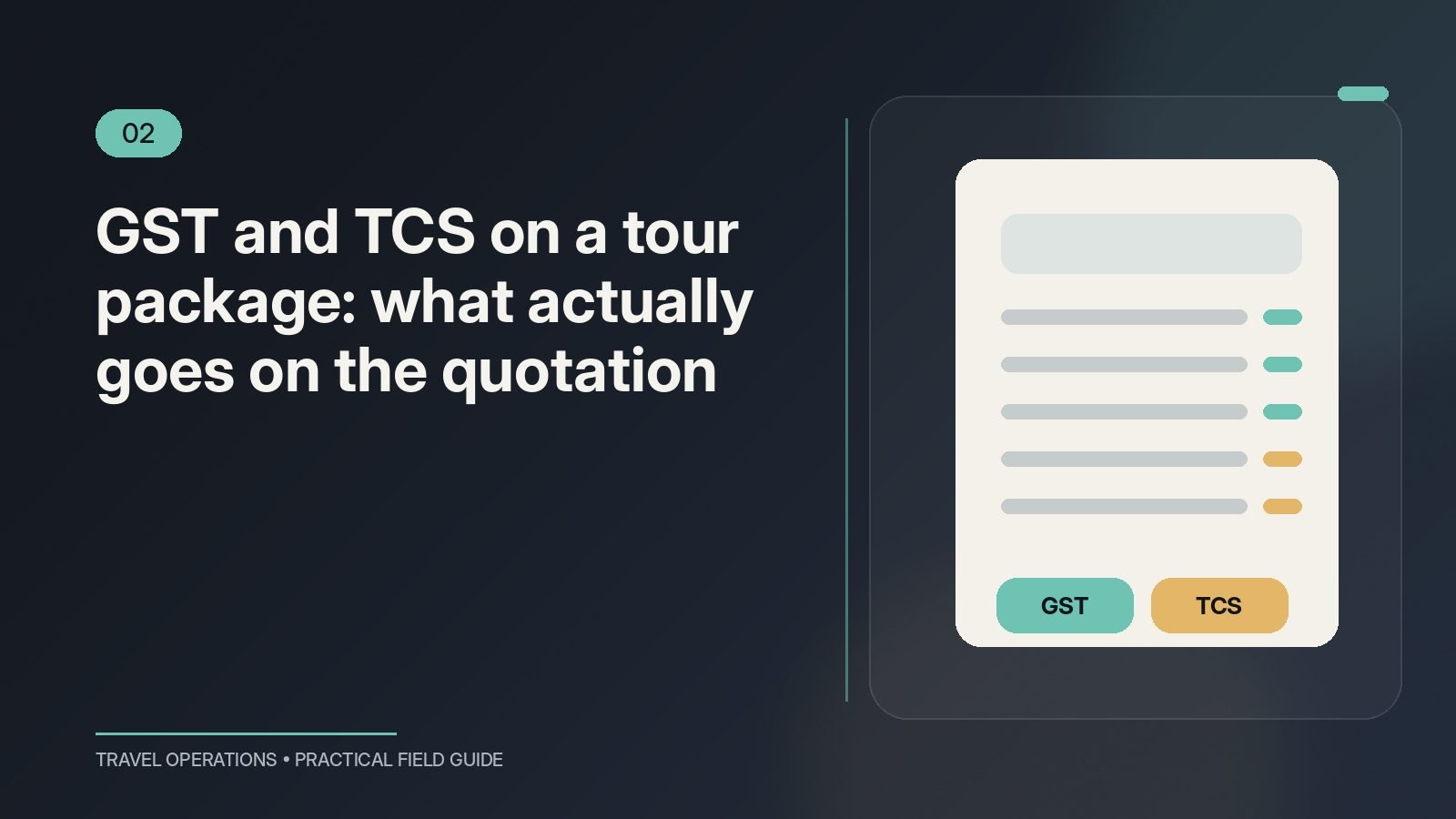
Three separate lines, never one number.
- The package value.
- GST, with the rate stated, on that value.
- TCS, with the rate stated, described as collected against the traveller's PAN.
A single "₹1,84,000 all inclusive" is where every dispute starts, because the client cannot see which part is your price and which part is the government's, and neither can you six months later. Markup, GST and the lines your client sees covers what else belongs on that block, and what a travel quotation must include covers the rest of the document.
One last thing, and it is the reason this post carries a date at the top: the correct figure is whatever is correct this week. Build the rate into your costing as a value you can change in one place, not as a number typed into four hundred documents.
Common questions
What is the GST rate on a tour package?
A tour operator has two routes: 5% on the gross package value with no input tax credit, or 18% with credit. The 5% option carries one carve-out — credit on tour operator services bought from another tour operator.
5% is not automatically cheaper. The question is how much embedded GST you are writing off on your own hotel and supplier bills, and that depends on what your costs are made of.
What is the GST on a hotel room in India?
Since 22 September 2025: a room at a value of supply up to ₹7,500 per unit per day is 5% without input tax credit, and ₹7,500 or above is 18% with credit. The band below ₹7,500 used to be 12% with credit.
The threshold is per room per night, so an upgrade from ₹7,200 to ₹7,800 moves the rate in one step rather than gradually.
How much TCS applies to a foreign tour package?
A flat 2%, from the first rupee, with no threshold — that is the position from 1 April 2026 under the table in Section 394(1) of the Income-tax Act 2025, the provision that was Section 206C(1G) of the 1961 Act. It replaced 5% up to a threshold and 20% above it.
If a quotation template still carries a 20% line, it is quoting a rule that no longer exists.
Is TCS refundable, and who claims it?
The traveller claims it. It is collected in their name against their PAN, appears in their tax statement, is set off against their tax for the year and refunded if they have overpaid. It is not your revenue and it is not a charge — you collect it and remit it.
Telling a client that plainly usually ends the objection: it is their tax, paid in advance, in their name.
Does TCS apply to a flight ticket on its own?
No. An overseas tour programme package needs two or more components — an international travel ticket, hotel accommodation, boarding or lodging, or expenditure of a similar nature. A ticket alone is not a package, and neither is a hotel booking alone. Sell them together and it is.
Is a tour for a foreign tourist in India exempt from GST?
No. A foreign tourist touring India is a service performed in India, so the place of supply is India and GST applies. Billing in foreign exchange does not make it an export. The same is true of an outbound tour sold to an Indian resident: both parties are in India.
Stop rebuilding the same quotation.
One rate card, one branded document, sent in minutes instead of an afternoon.
See what it does