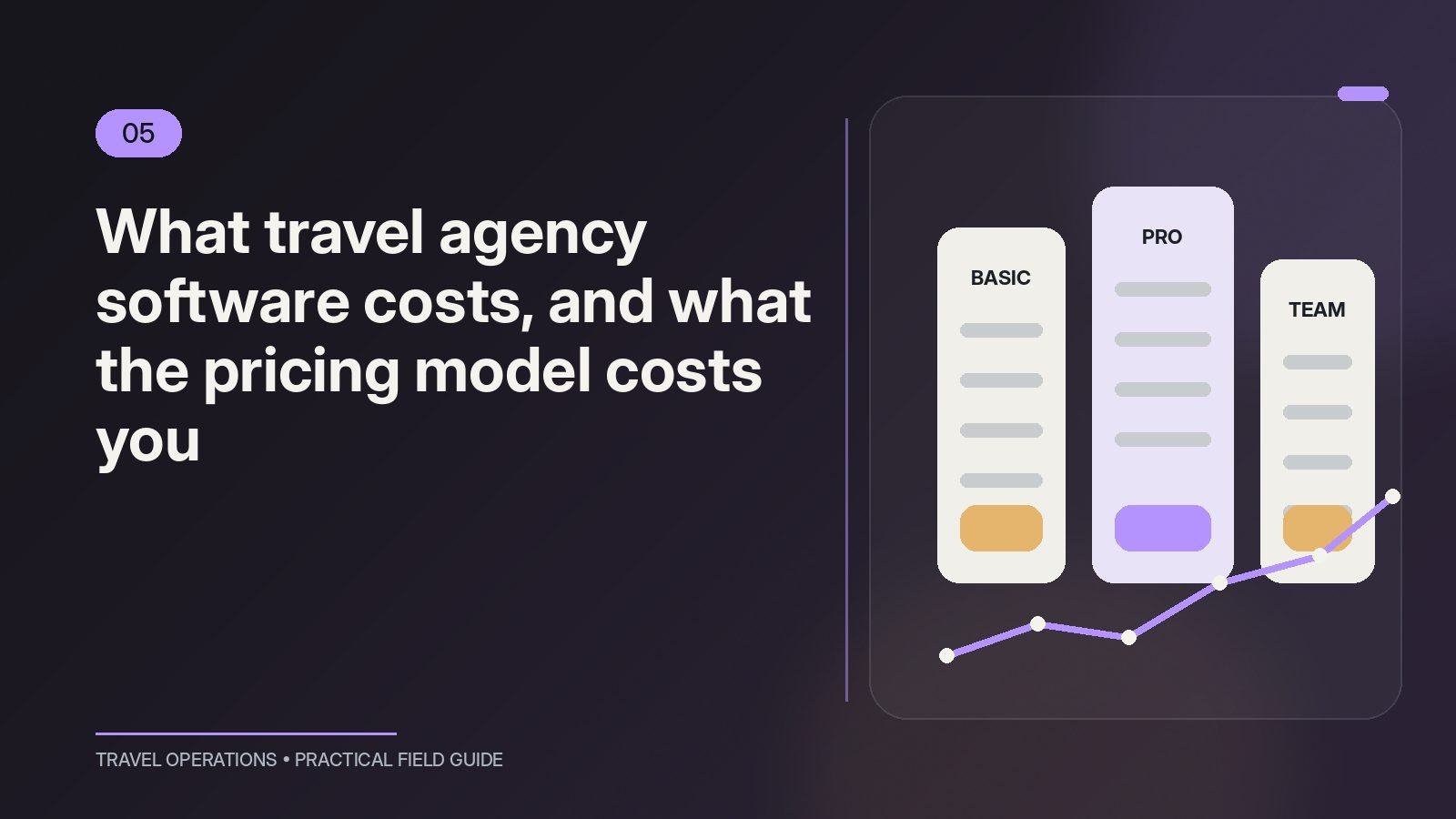
Ask what travel agency software costs and the honest answer is a range so wide it is useless: a few hundred rupees a month at one end, several lakh at the other. The number is not the useful question. The pricing model is, because that is what decides whether the cost grows with your business or against it.
The four models, and what each one punishes
- Per user, per month. The most common. It punishes hiring — every new person selling is a new line on the bill, including the part-timer who logs in twice a week during season. Cheap at two users, a real number at fifteen.
- Per quotation or per booking. Punishes a good season, which is the season you can least afford a surprise in. Fine if your conversion is high; expensive if your business is to quote widely.
- Flat tier by feature. Predictable, and the trap is the feature that sits one tier up — usually multi-currency, white labelling, or more than one user role. Check which tier the thing you actually came for lives in before you compare the headline prices.
- One-time build or licence. Large number, no recurring bill, and you own the maintenance. The recurring cost did not disappear; it moved to whoever keeps it running.
The costs that are not on the pricing page
These are usually larger than the subscription in year one.
- Getting your rates in. The real cost of every one of these platforms. Four hundred hotel rows, seasons, meal plans and vehicle day rates, typed by somebody. Ask whether it is your work or theirs, and if theirs, whether it is included or quoted separately.
- The parallel season. You will run the spreadsheet alongside for a few months because you should. That is real time, and it is the price of finding out where the two disagree before you trust either. See moving off the spreadsheet.
- Training the second person. Not you — the colleague who has to produce a correct quotation while you are on a call.
- Getting out. Ask about export before you need it: your rates, your clients and your quotations in a format you can read without the software. The answer is cheap to obtain now and expensive to discover later.
Work out what an hour of quoting costs you
This is the arithmetic that actually settles the decision, and it takes five minutes.
Take a month. Count the quotations that went out and estimate the honest average time to build one. Then count the enquiries you did not answer, or answered late enough that the answer no longer mattered. The first number is a labour cost; the second is revenue you never saw. Most operators find the second is the larger of the two, and it is the one no pricing page mentions.
Against that, a subscription is usually a small number. Against that, a subscription that does not actually reduce quoting time is a pure addition to cost, however cheap — which is why the test in the questions nobody demos matters more than the price.
What to ask before you see a number
- Which model, and what happens to the bill if I double my staff, or my bookings?
- Is rate loading included, and whose hours are they?
- Which tier holds multi-currency, white labelling and user roles?
- What does the second year cost, and is the first year discounted?
- Can I export everything, and will you show me the export?
One thing worth paying for
Support in October. Response times in a quiet month tell you nothing; the only ones that matter are in the weeks when you have forty live quotations and a hotel has changed its rates. Ask for the peak-season answer specifically, and ask what happens at nine in the evening, because that is when you will be quoting.
Common questions
How much does travel agency software cost in India?
Quoted prices run from a few hundred rupees a month to several lakh, which makes the number almost useless on its own. The pricing model tells you more: per user punishes hiring, per booking punishes a good season, flat tiers hide the feature you came for one tier up, and a one-time build moves the recurring cost to whoever keeps it running rather than removing it.
What costs are not on the pricing page?
Getting your rates in — four hundred hotel rows with seasons and meal plans, typed by somebody — is usually the largest cost in year one. Then the parallel season where you run your spreadsheet alongside, training the second person who has to produce a correct quotation while you are on a call, and getting your data out if you leave.
Ask whether rate loading is included and whose hours those are.
Is free travel quotation software worth using?
For one person quoting a handful of trips a month, possibly. The costs that bite are not the subscription: they are the rates you have to load either way, and what happens when you need multi-currency, a second user role or your own branding — which is normally where a free tier stops.
How do I work out whether it is worth it?
Two numbers from last month. The hours spent building quotations, and the enquiries you did not answer in time. The first is a labour cost; the second is revenue you never saw, and for most operators it is the larger of the two. A subscription is usually small against that — and worthless if it does not actually cut the quoting time, however cheap it is.
Stop rebuilding the same quotation.
One rate card, one branded document, sent in minutes instead of an afternoon.
See what it does