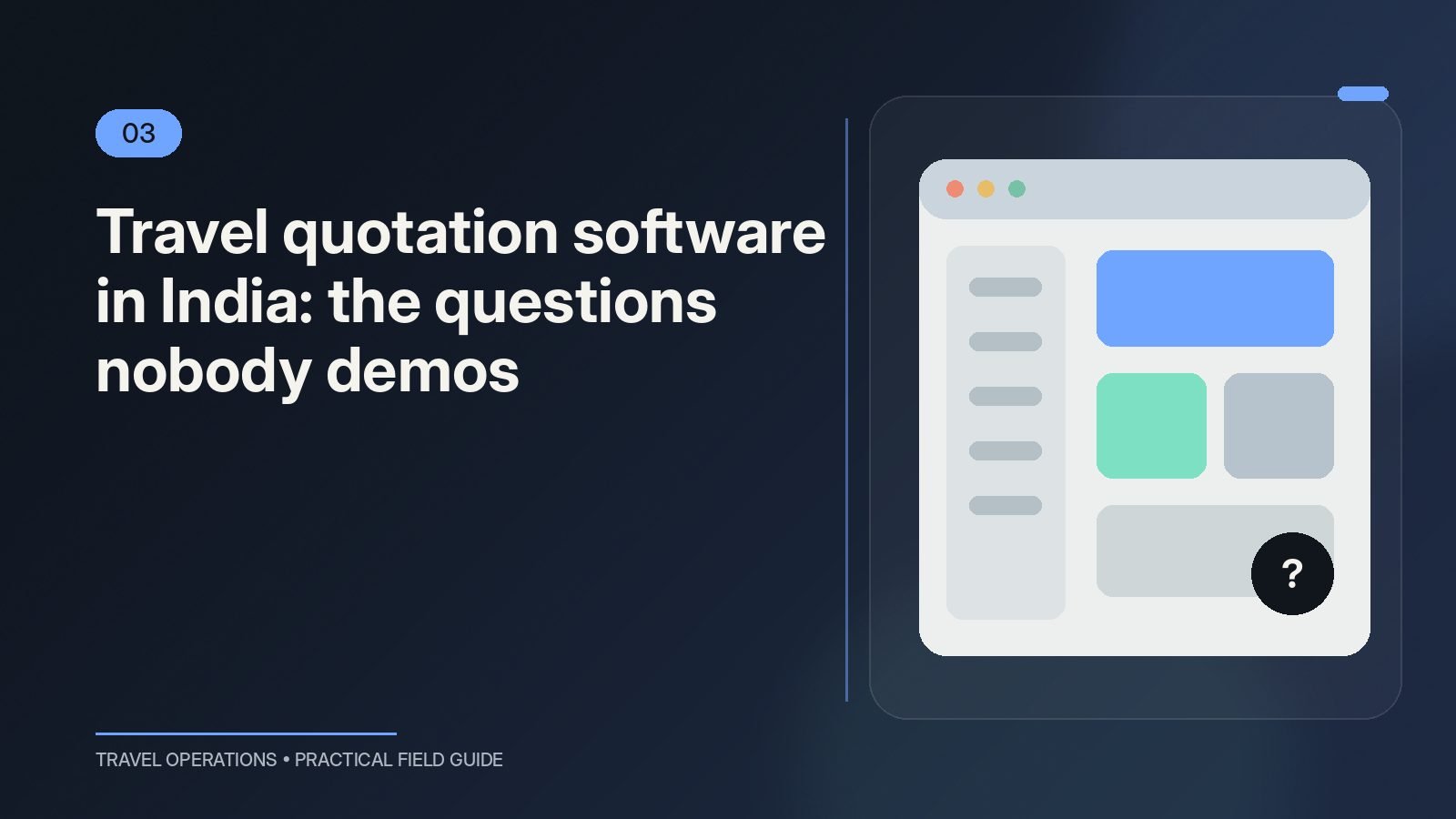
Every travel software demo looks the same for the first ten minutes. A lead arrives, somebody drags a hotel onto a day, a branded PDF appears, and the number at the bottom is correct. The question is what happens in the second week, when the enquiry is for nine people in three rooms across two countries and the hotel you quoted has moved its season dates.
This is a list of what to test in that second week, written for operators comparing the Indian platforms — Sembark, TraviYo, iTours, Travelomatix, TravelCarma and the rest — and wondering why they all sound identical on the pricing page. They are not identical. They differ on exactly the points nobody demos.
Where does a price come from?
The first question, and the one that decides most of the others. There are two designs.
- The quotation stores its own numbers. You type or paste rates into a document. Fast on day one. By month six you have four hundred documents, each holding a private copy of a rate that has since changed, and no way to answer "what are we currently quoting for Shimla?"
- The quotation is priced from a rate source. Hotels, vehicles and margins live in one place; a quotation reads them at the moment it is built. Slower to set up, and the only design where correcting a rate once corrects everything that has not been sent yet.
Ask the demo to change a hotel's contracted rate and then reopen a draft quotation that used it. What happens to the number tells you which of the two you are buying.
Can it quote a party that is not two adults?
Most rate charts are built per person on twin sharing, and most real enquiries are not. Three adults in one room, a child of nine with a bed and a child of four without, a solo traveller who must still be quoted against a double — each of these is a different line on the same chart.
Give the demo a family of two adults and two children of different ages and watch whether the software asks for the ages or quietly prices four adults. We wrote about why the room plan and not the head count is what carries the price in quoting two, four and six travellers.
Does it handle a supplier who does not invoice in rupees
The moment you sell Nepal, Bhutan, Bali or Malaysia, some of your cost lines arrive in another currency. Two things go wrong here, and they go wrong quietly: a platform that converts everything to rupees at a rate set months ago, and one that adds a dollar figure to a rupee figure because neither carries a currency of its own.
The safe design keeps each supplier's rate in the currency it was contracted in and states the currency on every line. Quoting in the supplier's currency covers the failure in detail.
What does the client actually receive?
A PDF is table stakes. The questions worth asking are about the other three: can the same quotation go out as a shareable link that stays current, as an editable document your client's travel desk can annotate, and as something that survives being forwarded on WhatsApp without becoming a wall of grey text? And does the branding on it belong to you or to the software?
Who can see your margin?
If your sales staff, your associates or your B2B agents all open the same screen, the platform has to decide what each of them sees. A system that shows the net cost, the sell price and the margin on one screen is a system where a sub-agent eventually sends a client a screenshot of your buying price. Ask specifically what a non-owner login sees.
Can somebody else keep the rates current?
The hidden cost of every one of these platforms is data entry. Four hundred hotels across five states change their rates twice a year, and somebody types all of it. Ask whether a hotel or a DMC partner can be given a login to maintain their own rows, and what stops them from seeing everybody else's.
What happens to the packages you already sell?
An operator with sixty routes does not want to rebuild sixty routes. Ask what a saved package actually stores — if it stores prices, it is stale the moment a season changes; if it stores the shape of the trip and prices it on demand, it is still correct next year.
The questions that are not about features
- Per user or per quotation? Seat pricing punishes you for hiring; volume pricing punishes you for a good season.
- Can you export? Your rates, your clients and your quotations, in a format you can read without the software. Ask before you need it.
- Who answers in October? Support response times in a peak month are the only ones that matter.
An honest note on this list
We build one of these — that is not a secret and it should not be a footnote. What is worth taking from the list regardless of what you choose is the shape of the test: do not evaluate on the first quotation. Evaluate on the fortieth, on a season change, and on the day somebody who is not you has to build one.
Common questions
What is travel quotation software?
Software that turns an enquiry into a priced, branded quotation: it holds your hotel and vehicle rates, builds an itinerary, prices it for the party and rooming in front of you, and produces a document you can send. The distinction that matters is whether it prices from a rate source or simply stores whatever numbers you typed into the last document.
Which is the best travel quotation software in India?
There is no single answer, and anybody who gives you one is selling. The platforms most Indian operators compare — Sembark, TraviYo, iTours, Travelomatix, TravelCarma and others — describe themselves almost identically, and they differ on things a first demo never reaches: where the price comes from, whether a mixed party is priced properly, whether a supplier's own currency survives, who can see your margin, and who keeps four hundred hotel rates current.
We build one of these, which is worth stating plainly. The list of tests is useful whichever you choose.
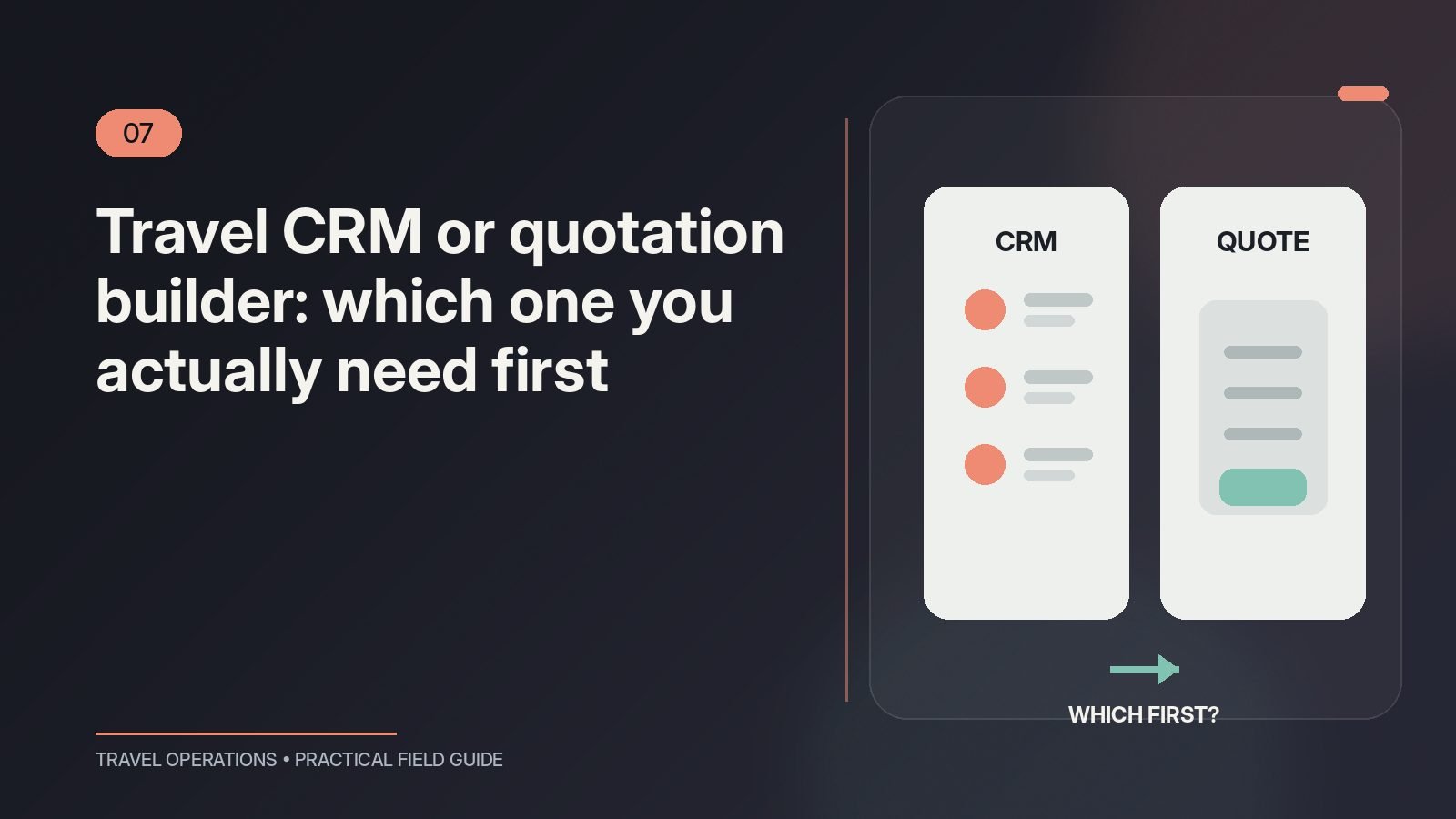
Do I need a travel CRM or quotation software first?
Count two things from last month: how many enquiries you failed to answer or answered late, and how long one quotation took to build. If the second number is an hour or more, fix costing first — a CRM will otherwise just tell you in a dashboard that you are still an hour behind on everything.
Can travel quotation software handle multiple currencies?
Some can and many cannot, and the failure is quiet. The design to look for keeps each supplier's rate in the currency it was contracted in and states the currency on every line. What to avoid is a single base currency with one conversion rate typed into a settings box months ago, and a total that adds two currencies together because no line carries its own.
Stop rebuilding the same quotation.
One rate card, one branded document, sent in minutes instead of an afternoon.
See what it does