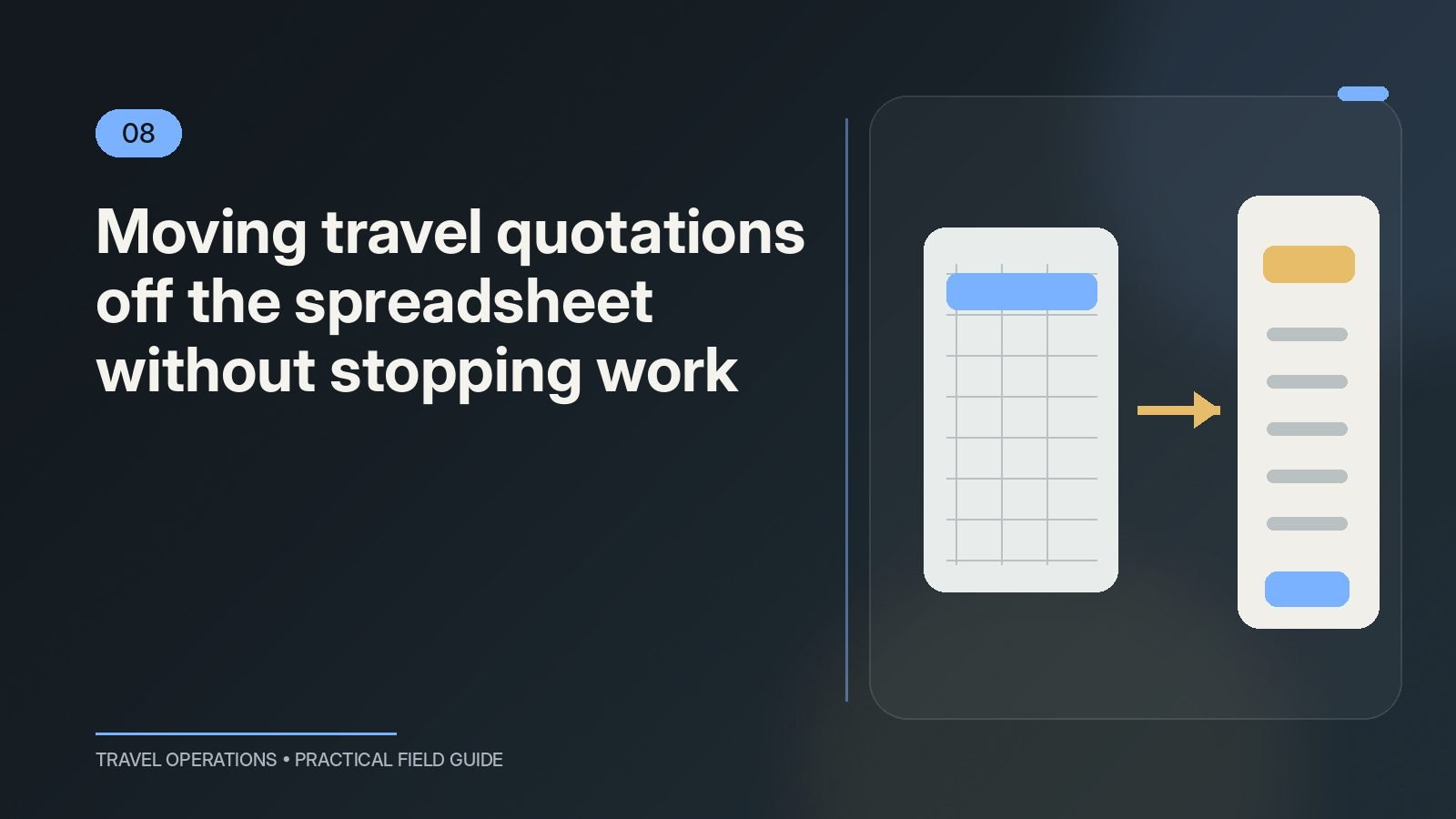
Almost every tour operator starts in a spreadsheet, and the spreadsheet is genuinely good. It is free, it does arithmetic, it never asks you to log in, and it does exactly what you tell it. The case for leaving is not that Excel is bad software. It is that a quotation is not a calculation — it is a calculation plus a set of facts that go out of date.
The four failures, in the order they arrive
- The copy. Every new quotation begins as "Save As" of the last similar one. It inherits last season's hotel rates, the client name in one cell nobody replaced, and any mistake that was in the original.
- The private rate. A rate typed into a quotation lives only in that file. When the hotel raises it, there is no list of the forty files that are now wrong.
- The broken formula. An inserted row, a dragged cell, a total that silently stops including the vehicle. Spreadsheets fail without an error message, which is what makes this the expensive one.
- The second person. The day somebody else has to build a quotation, everything that lived in your head — which sheet is current, which column is net, why that cell is hard-coded — has to be explained, and usually is not.
What to keep
Do not throw the spreadsheet away as the first step. It contains your actual cost knowledge, and that is the valuable thing — years of hotel rates, vehicle day rates and margins that took real money to learn. It is the container that is the problem, not the contents.
The first move is to separate the two things the sheet is doing at once: holding rates, and producing a document. Pull the rates out into their own list — hotel, town, category, season, meal plan, room type, rate — and you will find you can already answer questions you could not answer before, like which towns you have no rate for at all.
Doing the extraction without stopping work
- One town at a time. Start with the route you sell most. A complete rate list for one circuit is more useful than a partial one for five.
- Rates, not quotations. Resist importing your old documents. They are snapshots and most of them are already wrong; what you want is the current rate for each supplier.
- Write down the season dates. This is the piece that is almost always in somebody's head rather than in the sheet, and it is the piece that makes a rate correct or wrong. See reading a hotel rate sheet.
- Keep the sheet running in parallel for a season. Build the next few quotations both ways and compare the totals. Where they differ, one of them is wrong and you want to know which before you trust either.
What you should expect to gain, and what you should not
You should expect the second quotation for a route to become minutes rather than an hour, a rate correction to apply everywhere at once, and somebody other than you to be able to produce a document that is right.
You should not expect the first quotation to be faster. Setting up a rate list is work, and anybody who tells you otherwise is selling. The gain is entirely on repetition, which is also why operators who sell many variations of a few routes get the most out of the move and operators who sell one bespoke trip a month get the least.
The test that matters
Before you commit, take one real enquiry you have already quoted from the spreadsheet, and rebuild it in whatever you are considering. Not a demo enquiry — a real one, with the odd rooming and the child of eleven and the hotel that was full. If the total matches your sheet, you have found something that understands your business. If it cannot represent the awkward part, the spreadsheet will survive alongside it and you will be running two systems.
Stop rebuilding the same quotation.
One rate card, one branded document, sent in minutes instead of an afternoon.
See what it does