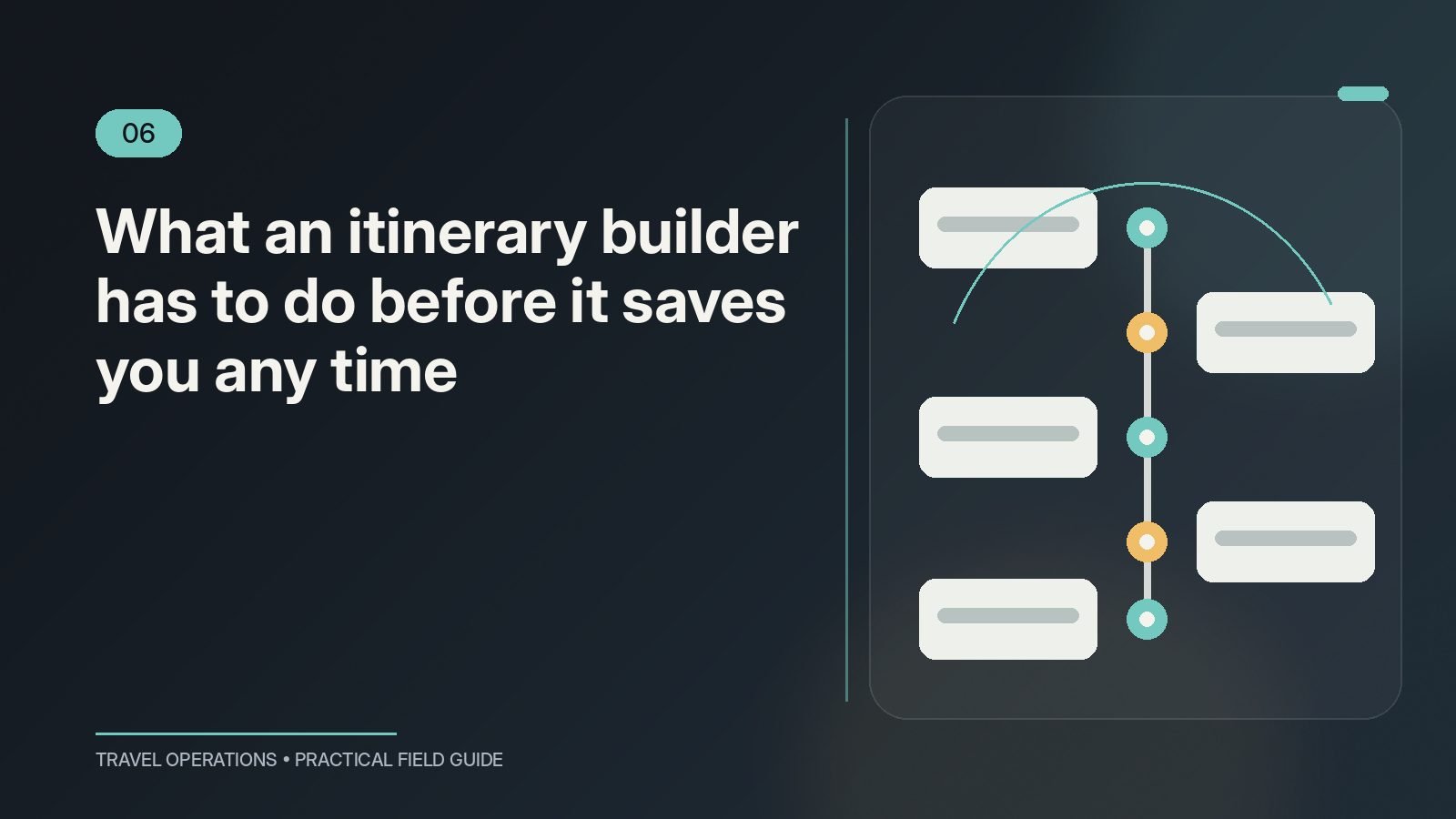
"Itinerary builder" is the phrase every travel platform leads with, and it describes two completely different products. One arranges words on a page. The other arranges words on a page and knows what they cost. The gap between them is where an hour of your week goes.
The presentation builder
This is the common one. You add days, type what happens on each, attach photographs, choose a theme, and export something that looks professional. It is genuinely useful — a good-looking document wins work, and typing an itinerary into a template beats typing it into an email.
What it does not do is know that Day 3 is a night in Pokhara at deluxe category in April, and that this is a number. The price is still something you work out elsewhere and paste in, which means every change to the trip is two pieces of work: change the words, then rebuild the number.
The costed builder
Here the itinerary is the input to the price rather than a document beside it. A day is a stop, a night, a category and a vehicle; those resolve to rates; the rates resolve to a total. Move a night from Manali to Kasol and the total moves with it, without anybody rebuilding anything.
The test is trivial and almost nobody runs it in a demo: build a five-night trip, then delete the third night. If you have to go and fix the price, you are looking at a presentation builder with a total field.
The eight things a costed builder has to represent
- A stop that is not a hotel name. Most quotations go out at a category — "deluxe in Shimla" — with the hotel named later or listed as "or similar". A builder that requires a specific hotel forces a fiction on day one.
- A different category per stop. Real trips are mixed: premium in the two towns that matter and standard in the transit halt. One category for the whole trip is the single most common oversimplification.
- Rooms, not people. Nine travellers might be three triples or four rooms with a single supplement, and those are different prices.
- Meal plans per night. A room-only night inside an otherwise half-board trip is normal, and it changes the rate.
- More than one vehicle. Large groups take two cars, and a hill section sometimes takes a different vehicle from the plains section.
- Days that are not nights. Arrival and departure days, day trips, a heli leg — none of them are a hotel night and all of them cost money.
- Seasons. The same trip in April and in July is not the same price, and the builder has to know the date, not just the duration.
- An unpriced line, stated honestly. Sometimes one supplier has not come back. The builder should let you quote the rest and mark that line open rather than forcing a zero.
Reuse is the actual feature
The time saved is not in building one itinerary. It is in the fact that most of your enquiries are variations of routes you have sold before. What matters is what a saved route stores: if it stores prices, it is stale by next season and you will rebuild it anyway. If it stores the shape — stops, nights, categories, vehicle — and prices it fresh each time, it is still correct in a year.
That distinction is worth pressing on in any demo, because both are described with the same word: "template".
What the client should get out of the other end
One itinerary, several shapes: a document to print, a link that stays current when you revise it, and a version without your internal costings on it. If producing the client-facing version means deleting rows by hand, that is a step you will forget once, and once is enough.
Related: one quotation, four ways to send it, and what a travel quotation must include.
Common questions
What is an itinerary builder?
The phrase covers two different products. One arranges days, text and photographs into a document that looks professional. The other does that and knows what each day costs, so the price moves when the trip does. Both are sold with the same words.
How do I tell a costed builder from a document template?
Build a five-night trip and delete the third night. If you then have to go and fix the price by hand, you are looking at a presentation builder with a total field.
Can it quote a hotel category instead of a named hotel?
It has to. Most quotations go out at a category — deluxe in Shimla, premium in Manali — with the hotel named later or listed as "or similar". A builder that demands a specific property on day one forces you to state something you do not yet know, and real trips are mixed anyway: the two towns that matter at a higher category and the transit halt at a lower one.
What should a saved itinerary actually store?
The shape, not the prices. If a template stores a price it is stale by next season and you will rebuild it; if it stores the stops, nights, categories and vehicle and prices them fresh against the travel date, it is still correct in a year. Both get called "template", so ask which one you are buying.
Stop rebuilding the same quotation.
One rate card, one branded document, sent in minutes instead of an afternoon.
See what it does