A quotation is the only document most clients read end to end. It is also, until a contract exists, the thing both sides will argue from — which is why the arguments are almost never about the price. They are about what the price was supposed to cover.
Here is what a B2B travel quotation has to carry, and what goes wrong when a line is left out.
1. Who the trip is for
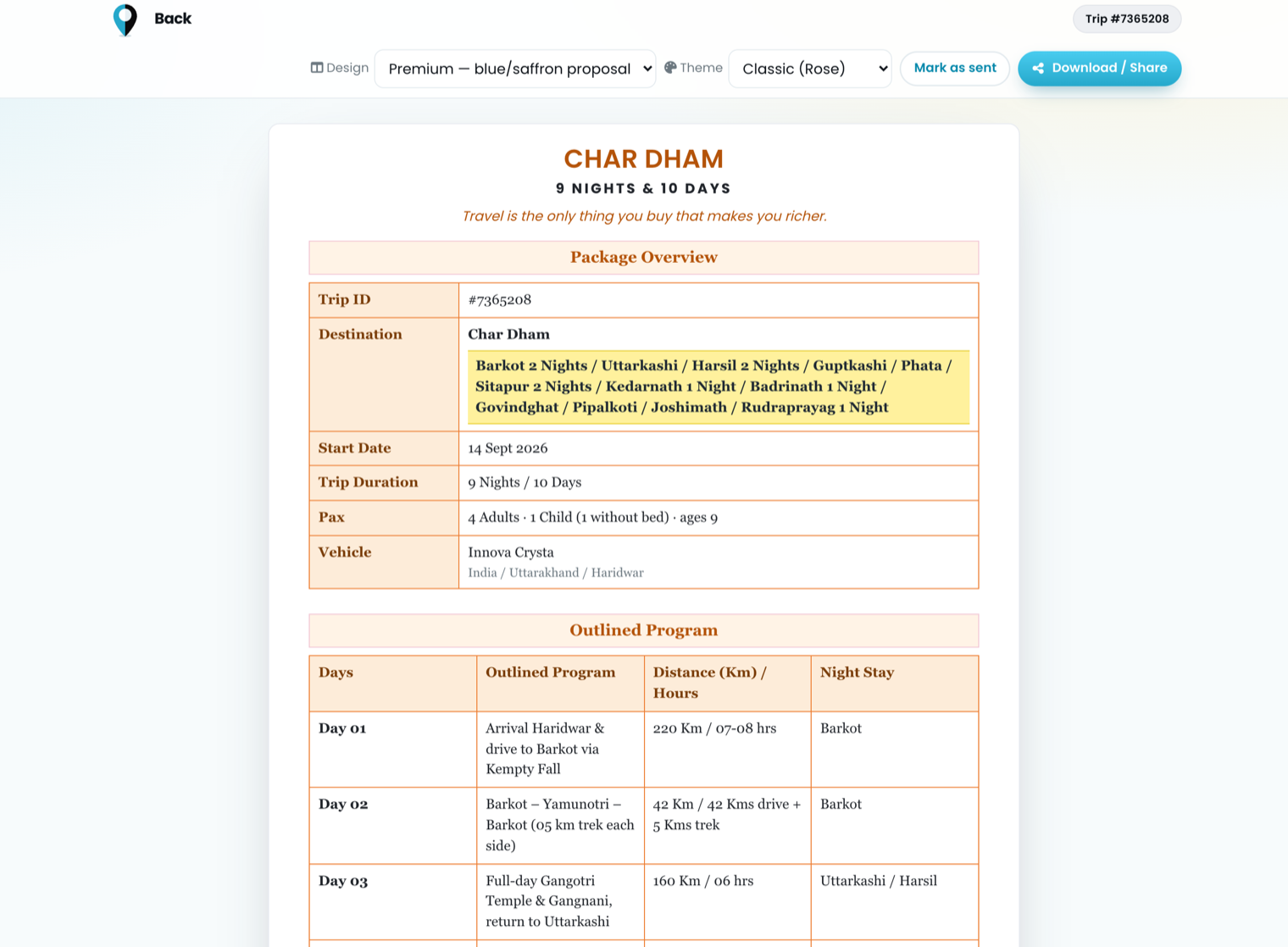
Not "6 pax". Four adults and two children, aged nine and three, in two rooms. Pax alone does not price a trip: the same six people are three different quotations depending on how they sleep and how many of them are paying an adult fare.
2. The dates, and what a night means
Arrival date, departure date, and the number of nights — not days, which people count differently. A "5 day Char Dham" is four nights to one operator and five to another, and the difference is a hotel night and a vehicle day.
3. The route, night by night
Which town the party sleeps in on each night, in order. This is the spine of the costing and the first thing a client compares against a competing quote. A day-wise programme without the overnight town in it is a brochure, not a quotation.
4. The hotel, or the category — but say which
Naming the property is strongest. Where you cannot commit yet, quote a category per stop and say so plainly: Standard in Barkot, Deluxe in Guptkashi. "3 star or similar" is not a category, it is a hedge, and every client has learned to read it as one.
5. The meal plan, per stop
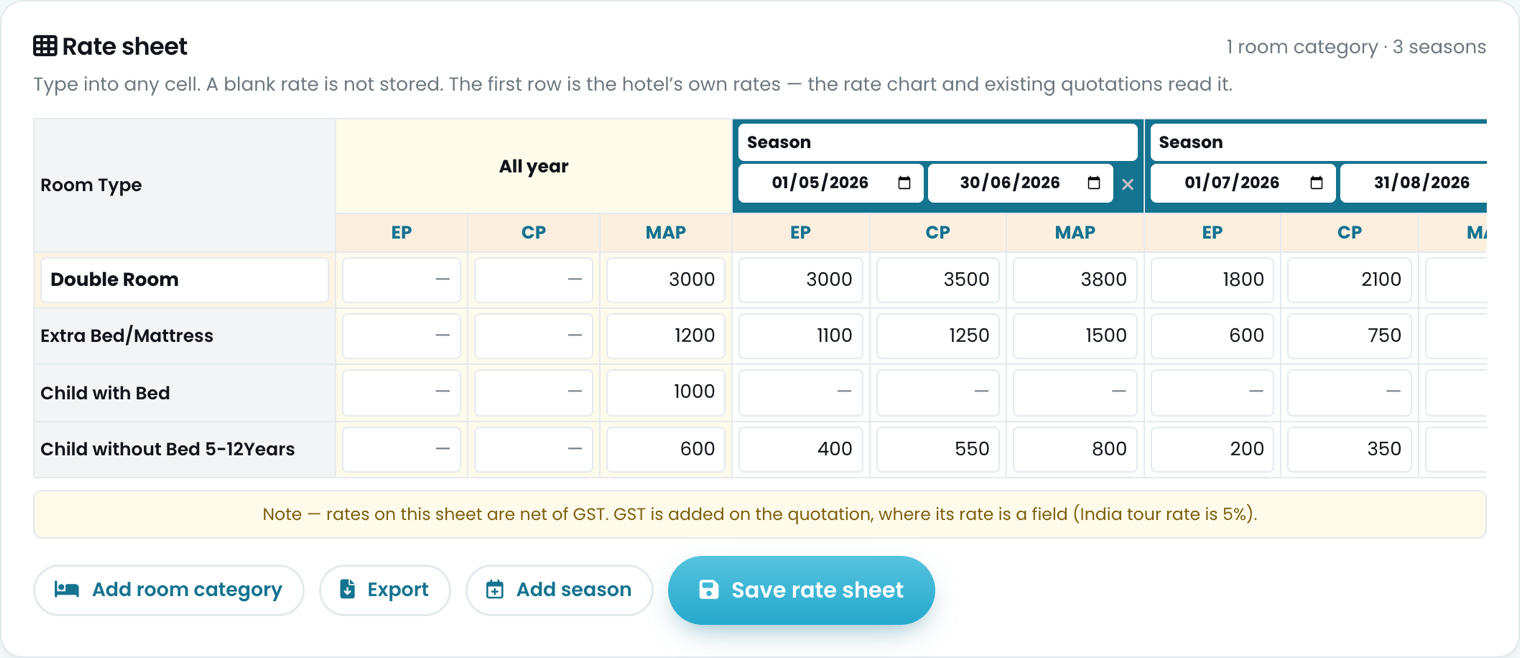
EP, CP or MAP — and if it changes along the route, say where it changes. Meals are the second most common source of a disputed invoice after room category.
6. The vehicle, and what it does not do
Model, capacity, and whether it stays with the party or drops and returns. Local sightseeing inside a town is often a separate arrangement from the point-to-point transfer; if it is, that belongs in writing before departure rather than in a phone call after it.
7. Inclusions, in the client's language
Write them as things the traveller receives — nine nights' accommodation on twin sharing, breakfast and dinner at each hotel, a dedicated Innova with driver for the full circuit. A list that only makes sense to someone who already knows the trip is not an inclusion list.
8. Exclusions, more specific than the inclusions
Air fare, personal expenses, pony and palki at the Dhams, helicopter tickets, entry fees, anything caused by weather or a road closure. The exclusion list is what protects the margin when the trip does not go to plan, and vagueness here always costs the operator, never the client.
9. The price, and the unit it is quoted in
Per person on twin sharing, or a package total for the party — one or the other, labelled. A per-person figure without its occupancy is the single most expensive omission in this list, because the client will assume the cheaper reading of it. There is more on how those numbers are built in quoting the same trip for two, four and six travellers.
10. Tax, once, at a stated rate
One line, one rate, stated as included or extra. Tax folded silently into two hundred hotel rows cannot be checked by the client or corrected by you when the rate changes. Markup, GST and the lines your client actually sees goes through it.
11. Validity, payment and cancellation
Rates move; a quotation without a validity date is an open offer against a season sheet that has already changed. State how long it holds, what the advance is, and what cancellation costs at each stage. These three lines settle more disputes than every other line combined.
12. Your name on it
Your brand, your contact, your terms — not your software's, and not a template's. A client who has to ask who sent the document has already lost some confidence in it.
The test
Hand the quotation to somebody in your office who was not on the call. If they can tell you where the party sleeps on night four, what they eat, who pays for the pony, and what happens if the road shuts — it is finished. If they have to ask, the client would have asked too, and a client who has to ask usually asks somebody else at the same time.
Every one of these lines is a field on a travee+ quotation rather than a paragraph somebody remembers to type. See what one looks like on the packages page, or read one quotation, four ways to send it.
Stop rebuilding the same quotation.
One rate card, one branded document, sent in minutes instead of an afternoon.
See what it does