An Indian agency sells a Bali package. The hotels invoice in rupiah, the transport in rupiah, the agency's client pays in rupees, and somewhere between those two facts a margin either survives or quietly disappears. The question is not "what is the exchange rate" — it is "who is carrying the risk, and on which day".
Keep supply in the currency it is bought in
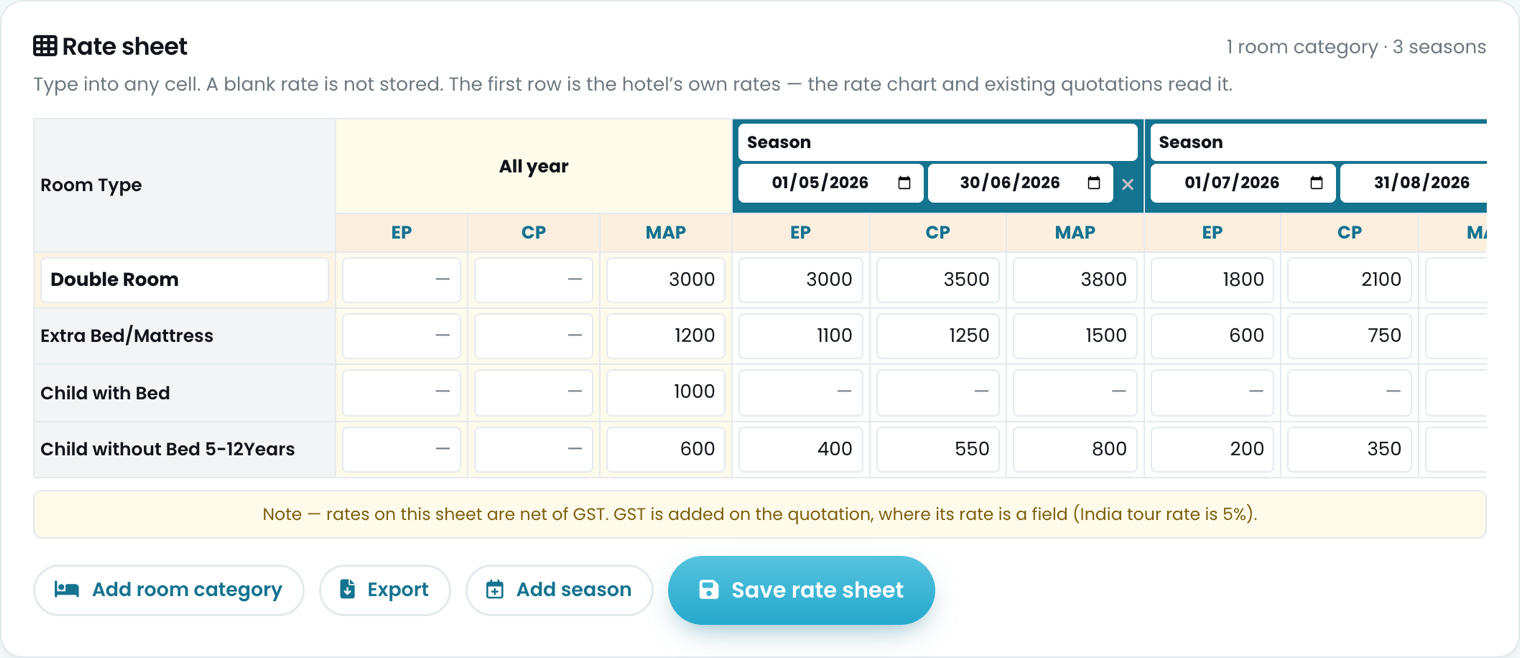
A hotel in Ubud has a rupiah rate. Storing it as a rupee number freezes an exchange rate into your cost base on the day somebody typed it, and nothing about that number will tell you later that it is stale. Keep the supply in its own currency; convert once, at the point where you actually quote, with a rate you chose deliberately.
That is how the desks on this platform work: Malaysia prices in ringgit, Indonesia in rupiah, Nepal in Nepali rupees, India in rupees. Nothing is converted behind the scenes, because a converted number that nobody can trace back is worse than no number.
A package with no rates in its currency should say so
The tempting shortcut is to take a package priced in one currency, multiply by today's rate, and publish the result. It looks complete and it is fiction: it prices a trip against hotels that have never been contracted at those rates.
The honest behaviour is to hold the package at its own price until that desk's rates are loaded. A blank is a question somebody can answer. An invented figure is a quotation you will have to explain.
Decide who carries the movement
Between the day you quote and the day you pay the supplier, the rate moves. Three ways to handle it, in increasing order of honesty:
- Absorb it — quote in your client's currency at a rate that includes a buffer, and keep the difference or wear it. Simple, and priced into your markup.
- Date it — quote in your client's currency with a validity date and the rate you used. Fair to both sides, and the reason validity belongs on every quotation.
- Pass it through — quote in the supplier's currency and let the client settle at the rate of the day. Common between agencies, rare with a retail traveller.
Any of the three is defensible. What is not defensible is quoting as though the rate is fixed and then repricing after the client has said yes.
Buffer, but say that you have
Most operators build two or three per cent into a cross-border quotation, and there is nothing wrong with that. Put it in the markup where you can see it, not in the exchange rate where you cannot — the day you need to know why a Bali trip earned less than a Nepal one, you want the answer in the margin line rather than buried in an arithmetic nobody recorded.
One document, whichever currency it is in
Symbol, decimal places and thousands separator all belong to the currency, not to the office that typed the document. A rupiah figure with two decimal places and a rupee comma pattern tells your Indonesian partner, immediately, that the quotation was built somewhere else out of somebody else's template.
Cross-border selling is the whole point of an alliance: five desks, five currencies, and the same document standard on all of them. There is more about how that is organised on about travee+, and the arithmetic that sits underneath is in markup, GST and the lines your client actually sees.
Stop rebuilding the same quotation.
One rate card, one branded document, sent in minutes instead of an afternoon.
See what it does