Every operator has a cancellation policy. Far fewer have one that a client agreed to in writing before the advance was taken, and the gap between those two facts is where a season's margin goes.
These are the terms worth settling on the quotation itself, before the trip is confirmed.
Match your terms to your suppliers', not to a template
Your exposure is what the hotels and the transporter will charge you, stage by stage. A policy copied from another company's website can be more generous than your own contracts allow, and you only find out on the day somebody cancels. Read the release periods on your own rate sheets first, then write a policy that sits just outside them.
Say what "cancellation" is timed from
Days before departure, counted from the arrival date, excluding the day of travel — put the counting rule in words. "30 days" is not a rule; "more than 30 days before the arrival date" is.
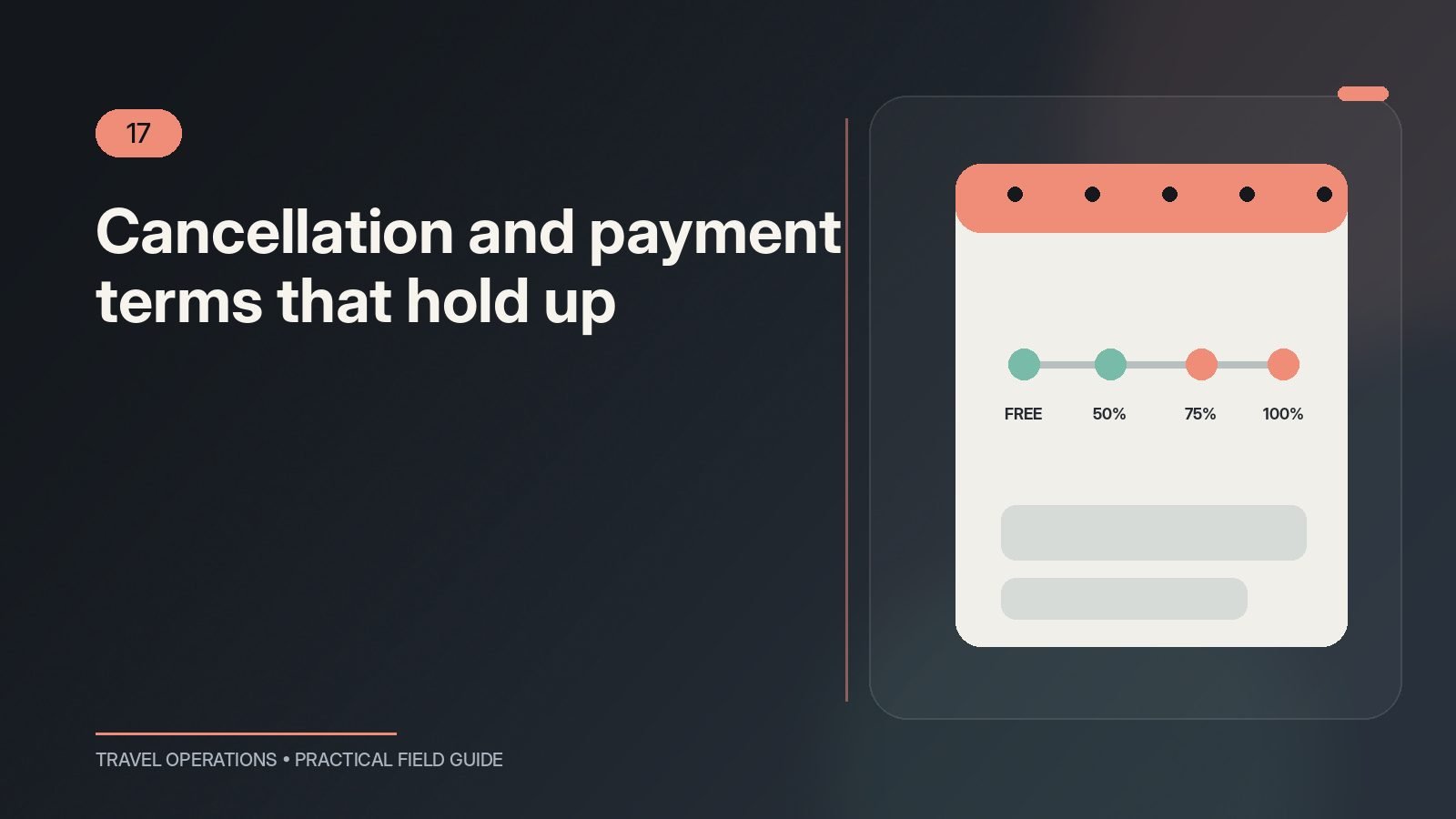
Stage the charges
- Before the release period — an administration fee, or nothing.
- Inside it — the advance, or a stated percentage.
- Close to travel — most of the trip cost, because your suppliers will charge you for it whether the party arrives or not.
- No-show — full, stated plainly rather than implied.
Name the non-refundable pieces separately
Train and air tickets, helicopter seats, permits, peak-date hotel blocks: these are frequently non-refundable from the moment they are bought, whatever the rest of the policy says. List them, so a client cancelling six weeks out is not surprised by the one line that does not follow the staircase.
Payment terms are two dates and two numbers
How much to confirm, and by when. How much before departure, and by when. Add what happens if the second date passes unpaid — a booking that is neither cancelled nor paid is the worst of both for you, because the rooms are blocked and the money is not there.
Peak dates deserve their own line
Long weekends, festival departures, opening week at the Dhams: hotels tighten their own terms on those dates and pass them straight through. If your policy is softer than theirs on those dates, you are underwriting the difference personally.
Put it where it will be read
Terms that live in an attachment nobody opens are terms you will argue about. On the quotation, under the price, in the same document the client says yes to — three or four lines, in plain language. What a travel quotation must include has the rest of what belongs next to them.
And date the quotation. A rate sheet moves between seasons; a quotation without a validity date is an open offer against prices that have already changed.
Stop rebuilding the same quotation.
One rate card, one branded document, sent in minutes instead of an afternoon.
See what it does