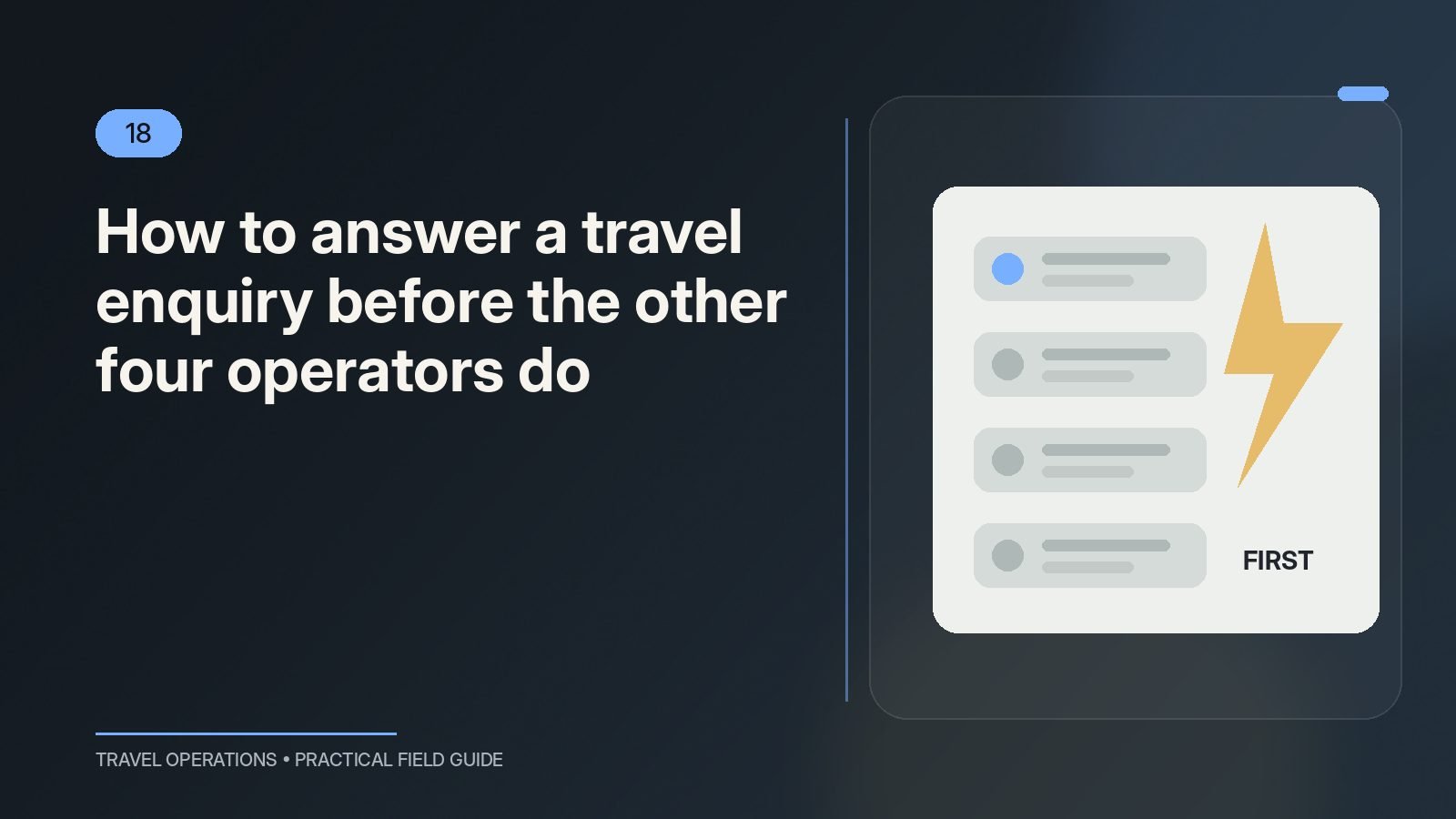
An enquiry has a half-life. The traveller who wrote to you at nine in the morning wrote to four other operators in the same ten minutes, and the one who answers with a real quotation first is usually the one who gets the conversation — not because they are cheaper, but because everybody else is still "working on it".
The obstacle is almost never willingness. It is that answering properly means rebuilding a costing from scratch. Here is how to take that hour apart.
Ask the four things that actually change the price
- Dates — arrival and departure, or the month and the number of nights.
- Party — how many adults, how many children, and their ages.
- Rooming — how they want to sleep, which is not the same as how many they are.
- Standard — the hotel category they have in mind, stop by stop if they have a view.
Everything else — dietary preferences, a temple they want to add, whether they mind an early start — is refinement. Those four are the costing. Ask for them in the first reply rather than waiting for a call that may not happen.
Send a real number, not a promise of one
"We will revert with a detailed quotation" buys nothing. A per-person figure, with its occupancy stated and a validity date, gives the traveller something to compare and gives you a position to refine from. If a stop is genuinely unpriced, quote the rest and say which line is open — an honest gap keeps the conversation; silence ends it.
Quote from the card, never from the last quotation
The fastest quote in your inbox is the one built from current rates rather than copied from last month's document with the dates overwritten. The copy inherits last season's hotel rates and the mistakes nobody caught the first time. How to price a Char Dham quotation in ten minutes walks through the sequence.
Reuse the shape, not the file
Most enquiries are variations of a route you have sold before. Save that route once, with its stops and nights, and a new enquiry becomes dates, party and category rather than a blank page. The second quotation of the week for the same circuit should take minutes.
Say what happens next
One line at the end: what the advance is, how long the price holds, and when you will follow up. A quotation that ends at the price leaves the traveller to work out the next step, and half of them will not.
Then actually follow up
Once, two days later, with something added rather than a repetition — a named hotel you have now confirmed, an alternative at a lower category, a note about the season filling. A follow-up that says "just checking" is a reminder that nothing has moved.
None of this is about typing faster. It is about not retyping at all: the enquiry that takes an hour is the one where the costing starts from nothing, and that is a workflow problem rather than a discipline problem.
Stop rebuilding the same quotation.
One rate card, one branded document, sent in minutes instead of an afternoon.
See what it does