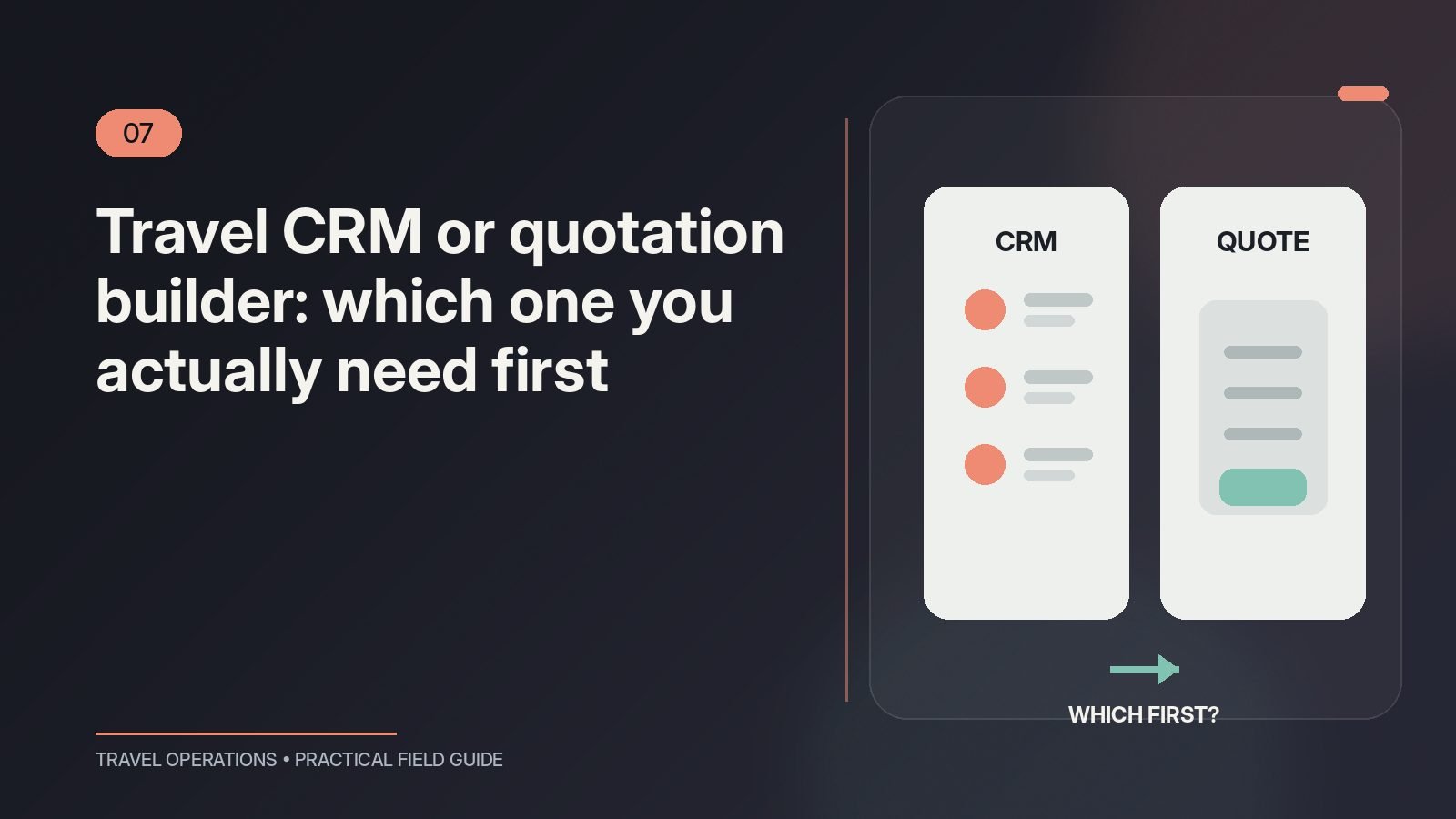
Two categories of software are sold to the same tour operator, often by the same salesperson, and they solve opposite halves of the problem. Buying the wrong one first is the most expensive ordinary mistake in this industry, because the wrong one still works — it just never touches the thing that is actually slow.
What each one is for
- A travel CRM manages the conversation. Where the enquiry came from, who owns it, what was promised, when to follow up, and what closed. It is a memory for your pipeline.
- A quotation builder manages the number. Which hotel at which category on which date, how many rooms, what the vehicle costs, what the margin is, and what the client sees.
A CRM with no costing engine will remind you to follow up on a quotation you still have to build by hand. A quotation builder with no pipeline will produce beautiful documents that nobody chases.
Which one is your actual bottleneck
There is a simple diagnostic. Take last month and answer two questions honestly.
- How many enquiries did you fail to answer at all, or answer more than a day late?
- How long did it take to produce one quotation, from the enquiry landing to the document going out?
If the first number is large and the second is small, you have a pipeline problem and a CRM is the right purchase. If the second number is an hour or more, a CRM will not help you: it will simply tell you, in a dashboard, that you are still an hour behind on every enquiry.
For most small and mid-size operators the second number is the problem, and it is a problem that compounds. An hour per quotation means you triage — you answer the enquiries that look serious and let the rest go cold, which is a decision made by how tired you are rather than by how good the lead was.
Why costing is the harder half to buy
Pipeline software is close to a solved problem, and a generic CRM will do a passable job of it. Costing is not generic. It has to know that a hotel has four categories and three seasons, that a double room can take a third adult at a different rate, that a vehicle is priced by the day and not by the kilometre, that a permit is per vehicle and a guide is per day, and that the whole thing has to be re-priced when the client says "make it four people instead of two".
None of that is configurable in a CRM's custom fields. This is why so many operators end up with a CRM and a spreadsheet — the CRM holds the client, and the actual number is still built by hand in Excel and pasted in.
The order that works
Fix the costing first, then wrap the pipeline around it. The reason is arithmetic: making quotations fast increases how many enquiries you can answer, which increases how many you need to track, which is when the pipeline tooling starts earning its cost. Doing it the other way round gives you a well-organised record of enquiries you did not have time to quote.
The exception is a team of more than about six people selling, where losing an enquiry between two staff is a daily event. At that size the pipeline is a real cost and the two purchases become simultaneous.
What to look for if you want both
Plenty of platforms now do both, which is usually right. When they do, check where the join is — whether a lead becomes a quotation without retyping the party, dates, rooming and category, or whether the two halves are separate screens that happen to share a login. The join is the whole value; without it you have bought two products and a copy-paste habit.
The related reading here is how to answer a travel enquiry before the other four operators do, which is really a description of what the join has to make possible, and what "rates on request" actually costs you, which is what happens when the costing half is missing.
Common questions
What is the difference between a travel CRM and quotation software?
A CRM manages the conversation: where the enquiry came from, who owns it, what was promised, when to follow up. Quotation software manages the number: which hotel at which category on which date, the rooming, the vehicle, the margin, and what the client sees. They solve opposite halves of the same problem.
Which should a small travel agency buy first?
Whichever addresses your actual bottleneck. If you are losing enquiries because nobody followed up, a CRM. If each quotation takes an hour to build, costing — because a CRM will otherwise report, accurately, that you are still an hour behind on every enquiry. For most small and mid-size operators it is the second.
Can a general-purpose CRM handle travel quotations?
Not the costing. Custom fields cannot express that a hotel has four categories and three seasons, that a double takes a third adult at a different rate, that a vehicle is priced per day rather than per kilometre, and that the whole thing must reprice when the party changes from two to four. This is why so many operators end up with a CRM and a spreadsheet.
Should I buy one platform that does both?
Usually yes — but check where the join is. A lead should become a quotation without retyping the party, dates, rooming and category. If the two halves are separate screens that happen to share a login, you have bought two products and a copy-paste habit.
Stop rebuilding the same quotation.
One rate card, one branded document, sent in minutes instead of an afternoon.
See what it does