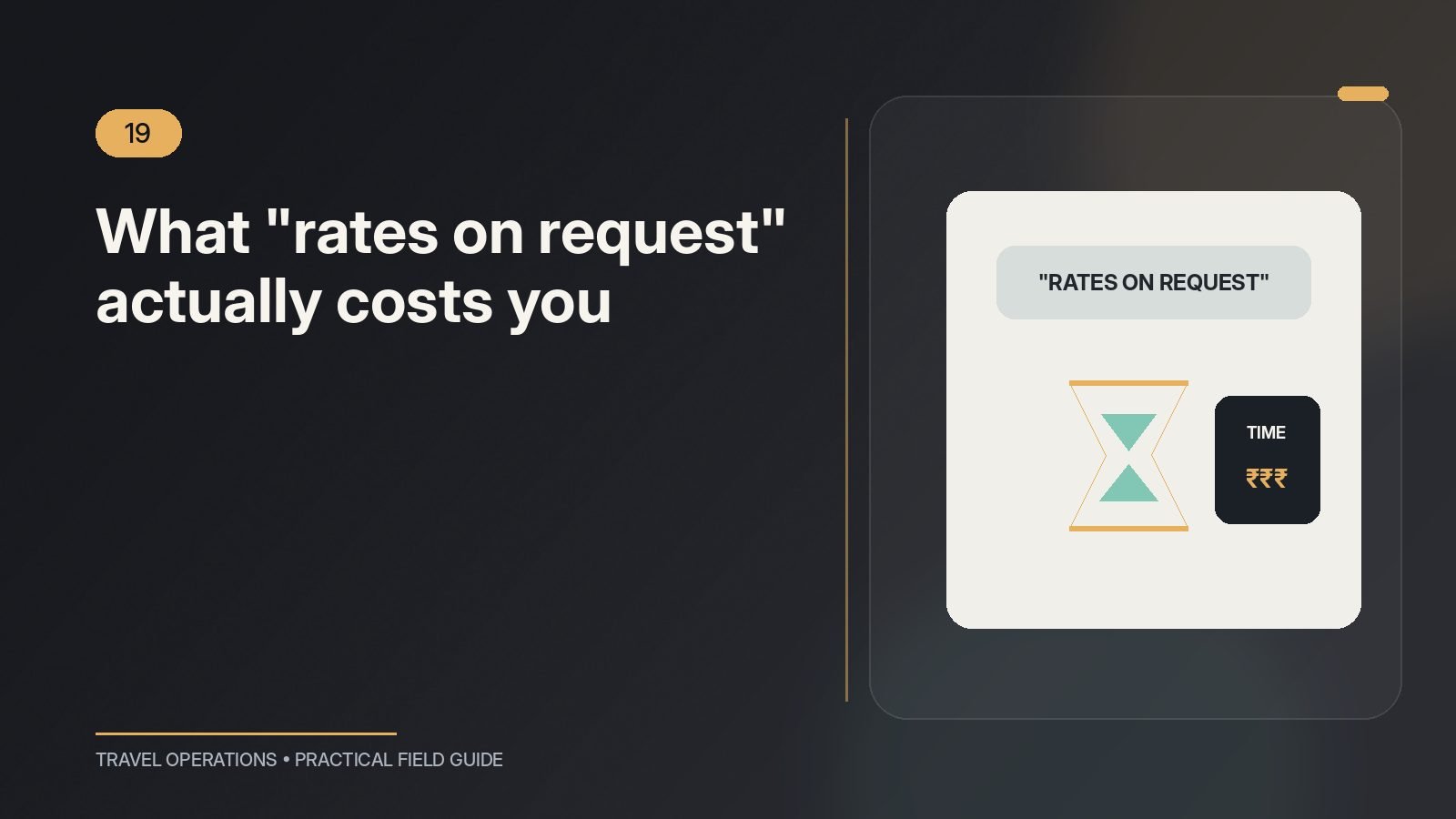
"Rates on request" is the politest way an operator can say we have not contracted this yet. Every catalogue carries a few, and there is nothing wrong with that — until you count what they cost.
What the words do to a buyer
An agent comparing three catalogues will price the two that answered and skip the one that did not. Not out of spite: they have a client waiting and a number they need. "On request" moves your package from a shortlist to a follow-up task, and follow-up tasks are done last or not at all.
The internal cost is worse than the lost enquiry
Each unpriced package generates the same conversation every time it is asked for: someone emails a supplier, waits, converts a rate in a message thread, and quotes a number that is never written back into the catalogue. The next enquiry starts from nothing again. A package priced once answers forever; a package on request costs an hour every time it is wanted.
An invented number is not the fix
The tempting shortcut is to take a similar package, add a margin, and publish the result. That is not a price, it is a guess wearing a currency symbol — and the first booking against it teaches you what the real cost was, at your expense. A number that is not the price is worse than no number.
Price it from what you do know
Most "on request" packages are not unknowable. The route is known, the nights are known, and the towns on it almost always have a rate on somebody's sheet — a contracted hotel in the next category, a published rate from a partner desk, a card rate for that town. Price from that, mark it clearly as indicative, and give it a validity of a fortnight. Indicative and dated beats missing.
Then close the gap properly
- List the towns that have no rate, rather than the packages that have no price. Ten packages usually block on two or three towns.
- Contract by town, not by enquiry. One rate sheet from one property in the town that blocks four itineraries unblocks all four.
- Write the rate back into the card the day it arrives, not into the email thread where you will not find it in March.
Keep the honest blank where it is honest
A package genuinely priced in a currency you have no supply in should keep its own price rather than carry a converted guess — selling across a border covers why. The distinction is between a gap you have decided to leave and a gap nobody has looked at. The first is a business decision; the second is just an old catalogue.
Hotel contracting: what to settle before you sign the rate sheet is the other half of this — the fastest way to stop quoting on request is to contract the towns that keep blocking you.
Stop rebuilding the same quotation.
One rate card, one branded document, sent in minutes instead of an afternoon.
See what it does