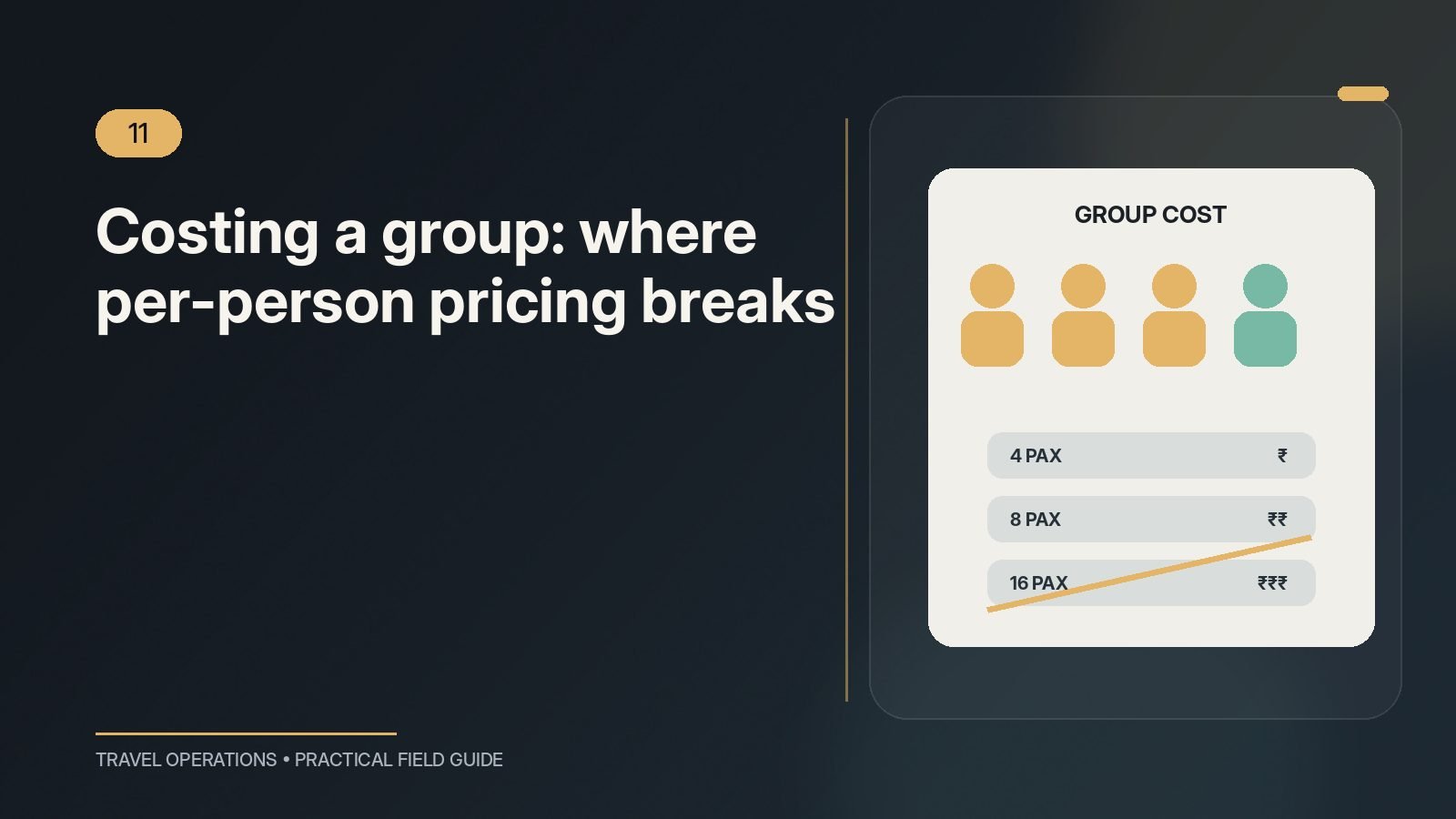
Per-person pricing works until the group gets big enough to change the shape of the trip. Then every assumption underneath the per-person figure stops holding at once, and the quotation that looked like arithmetic becomes a set of decisions.
Small parties are a different problem, covered in quoting two, four and six travellers. This is about the point where a group starts costing money in steps.
Vehicles move in steps, not slopes
The most common mispricing in group work. Twenty-six travellers is one coach. Twenty-eight is one coach and a car, or two smaller vehicles, and the per-person cost does not rise by two twenty-sixths — it jumps.
Quote a group by dividing a vehicle cost by heads and you will be wrong in both directions: too expensive at twenty-six, too cheap at twenty-eight. The number that has to exist in your costing is the capacity breakpoint, and the useful software behaviour is being told which breakpoint you are sitting next to.
The people who travel free are your cost
A tour leader, an escort, a driver's accommodation, a coordinator on a corporate movement. Each is a room, often a seat, sometimes a meal plan, and none of it is revenue.
Worse, the ratio changes. One escort for twenty is a different per-person load from one escort for forty-five, and a complimentary position granted by a hotel at twenty-five rooms disappears at twenty-four. These are not rounding items on a large group; they are a visible part of the margin, and they are the lines most often left out of a first quotation and remembered after it is accepted.
Rooming is a negotiation, not a calculation
Forty-two travellers is not twenty-one doubles. It is some doubles, some twins that the hotel counts differently, two or three singles at a supplement, a triple that a family asked for, and one person who will be reallocated at check-in. Until the rooming list exists you are quoting an assumption, and the quotation should say which assumption.
The line that prevents the argument is short: state the room plan you priced, and state that a change to it changes the price. See what the room words commit you to.
Corporate movements carry things leisure groups do not
- A meeting room, and what comes with it. Half-day or full-day, projector, a tea round priced per head per serving. Often a larger line than anybody expects.
- Banqueting rather than meal plans. A gala dinner is not a hotel MAP rate, and it is usually priced per person on a minimum guarantee — which means you are committing to a number of covers whether or not they turn up.
- Arrival windows. Forty people on nine flights across a day is nine transfers, not one, and early check-in for half of them is a day-rate charge.
- A name list that is not final. Corporate groups shed and add people up to the week before. The commercial question is at what point your quoted price stops flexing, which belongs in your terms rather than in a phone call.
Quote the band, and say it is a band
The practical answer to all of this is to price against a group-size band — 20 to 25, 26 to 32 — and to state the band on the document. It is honest, it protects the vehicle breakpoint, and it turns "the price went up" into "the group grew past the coach", which is a conversation rather than a dispute.
A single per-person figure with no band attached is a promise you did not mean to make.
The deposit is doing more work here
Group bookings hold inventory. A coach, twenty-one rooms and a banquet minimum are commitments you have made to suppliers on the strength of a quotation, and a group that quietly halves leaves you holding all of it. The release ladder and the cancellation stages matter more on a group than on any family trip, and they need to match what your suppliers will actually do to you — not a template. See cancellation and payment terms that hold up.
Stop rebuilding the same quotation.
One rate card, one branded document, sent in minutes instead of an afternoon.
See what it does