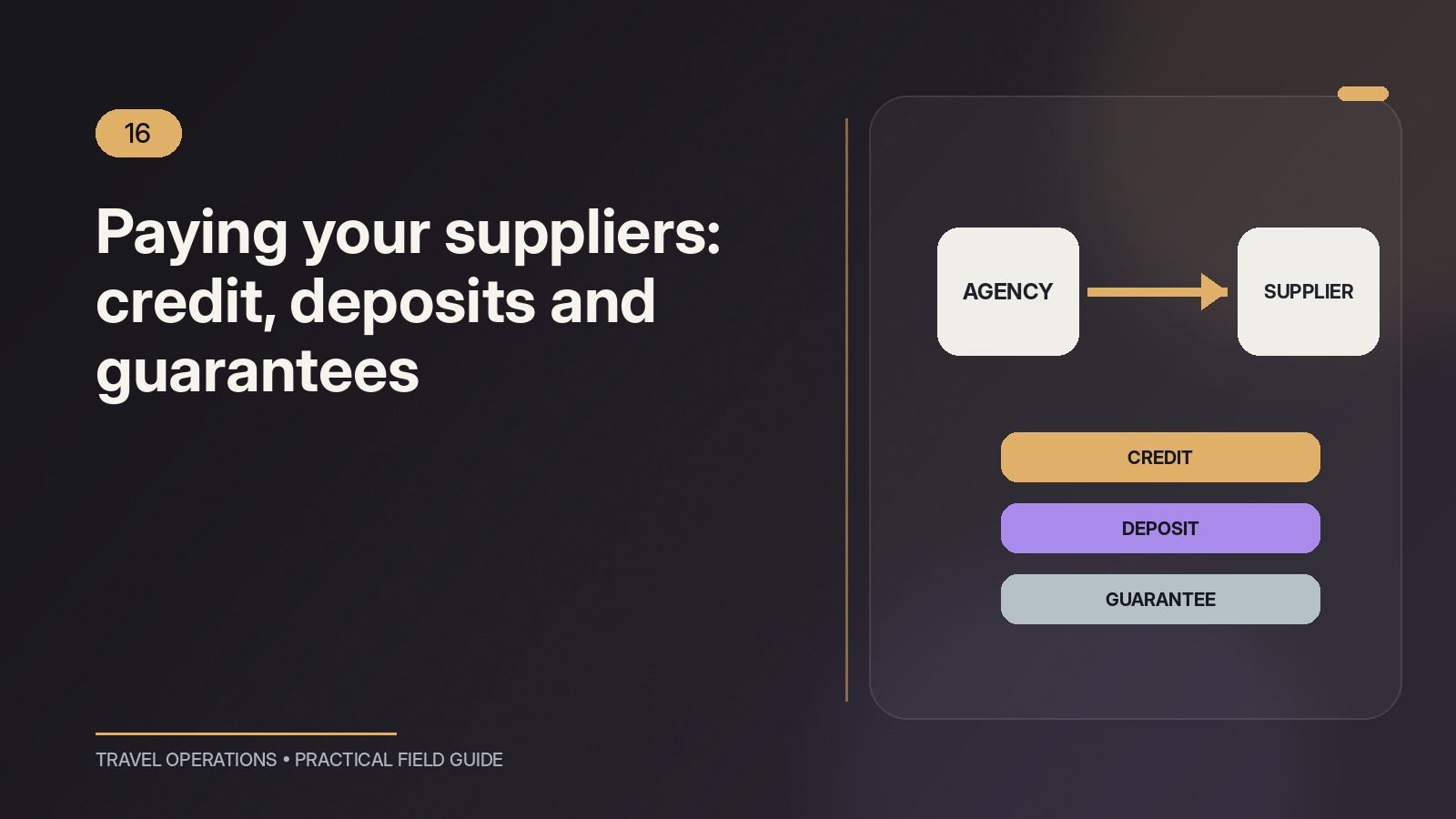
Cancellation and payment terms that hold up is about what your client owes you and when. This is the other half of the same cash cycle, and the half that actually decides whether a good season leaves you with money: what you owe your suppliers, and when.
The gap is the business
You take an advance from a traveller in July for a trip in October, and you pay the hotel somewhere between those two dates. Every operator is running a small treasury whether they think of it that way or not, and the two failures are opposite: paying suppliers earlier than you need to and running out of cash in the shoulder month, or spending an advance that belongs to a trip you have not yet paid for.
The discipline that prevents both is boring and works: know, per booking, what you have taken and what you have committed. A booking is not profit until the last supplier is paid.
What to negotiate, in the order it matters
- Credit period. Payment on checkout, seven days, thirty days. This is worth more to you than a one per cent better rate, and operators routinely trade it away for the rate because the rate is the number on the sheet.
- Advance or deposit. How much, when, and — the part people forget to ask — whether it is adjustable against a future booking or forfeited if this one cancels.
- Release date. When held rooms go back without charge. The single most valuable clause in a seasonal contract and the one most often left blank. See hotel contracting before you sign.
- Who pays for the change. A rooming amendment two days out, a late arrival, a no-show in a group of thirty. Agree the treatment before you need it.
A guarantee is a purchase
"Guaranteed" rooms and a banqueting minimum are not reservations, they are commitments you have bought. Twenty-one rooms held on a guarantee and a dinner minimum of forty covers means you owe that money whether or not the group turns up at that size. It belongs in your costing as a risk you are carrying and, usually, in your client's terms as a stage at which their money stops being refundable.
The mismatch to watch for is simple and expensive: your client can cancel later than you can. If a traveller may cancel at fourteen days and your hotel charges you from twenty-one, you have written yourself a seven-day window in which you refund money you have already lost.
Advance payments to a supplier you do not know
A new DMC in a country you have not worked before, asking for a wire before the trip. Sometimes unavoidable, and worth a few minutes of care: start with one small booking rather than a season, pay to a company account rather than an individual, get the confirmation naming the hotels before the money moves, and keep the first payment to a size you could absorb.
Keep the two ledgers next to each other
Most operators can tell you what a client owes them. Far fewer can tell you, in the same breath, what they owe out on that booking — and the answer is a spreadsheet nobody has opened since March. Per booking: taken, committed, paid. Three numbers.
They are also what makes a discount decision honest. A price reduction taken from margin you have already promised to a hotel is not a discount, it is a loss you have agreed to in advance. See how much margin should a tour operator take.
Stop rebuilding the same quotation.
One rate card, one branded document, sent in minutes instead of an afternoon.
See what it does