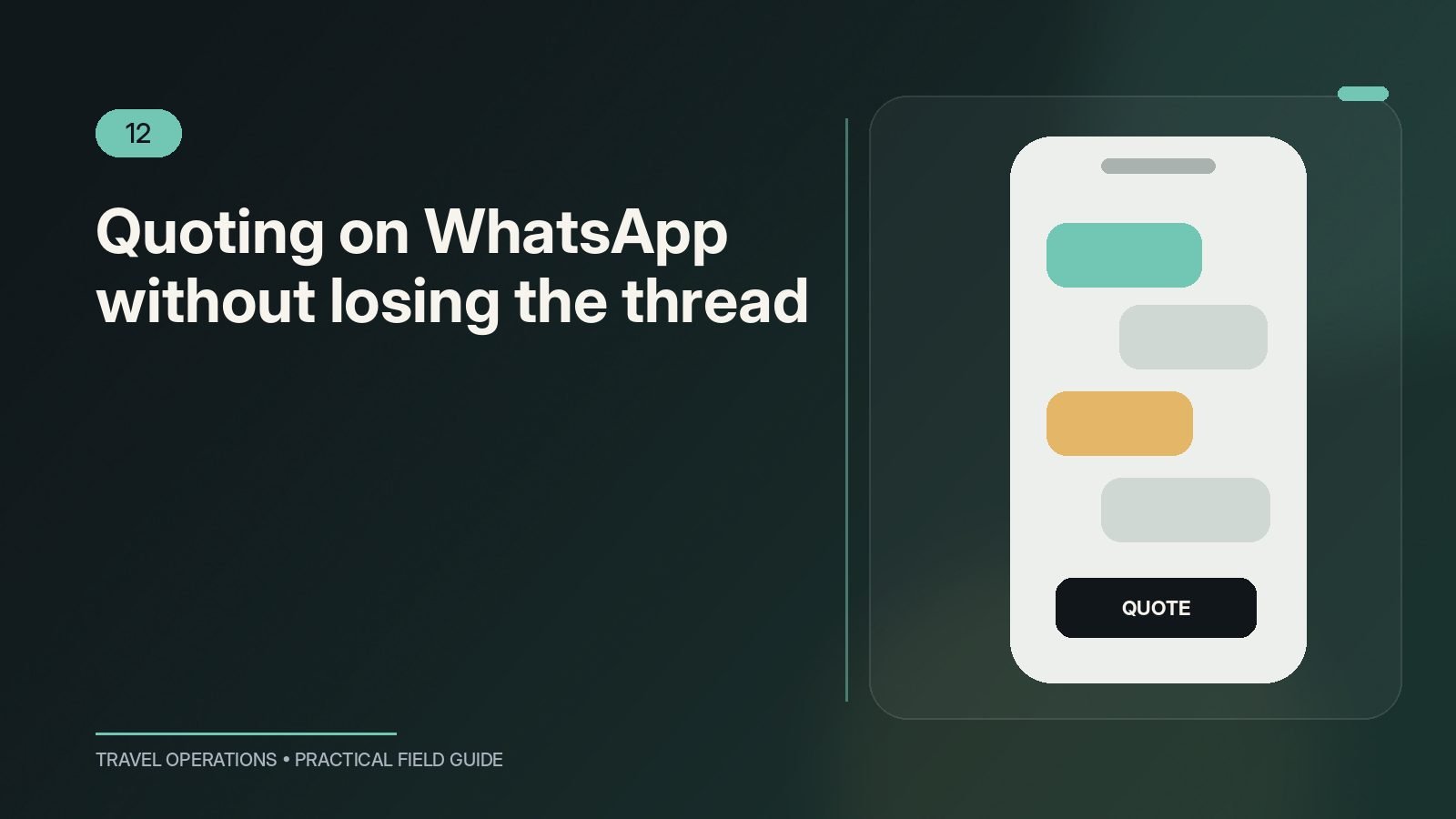
For most Indian operators the enquiry arrives on WhatsApp, the negotiation happens on WhatsApp, and the booking is confirmed on WhatsApp. The quotation, meanwhile, is a PDF built somewhere else and dropped into the thread — which is where a chat-first sales process quietly starts costing money.
This is not about which button sends the file. One quotation, four ways to send it covers the channels. This is about what the chat does to the document.
The thread is your only record, and it is not searchable
Three weeks after the enquiry, the agreed price is a number in a message somewhere above a photograph of a hotel lobby. What was included, whether the third adult was on a mattress or a bed, what date the price was good until — all of it is in the thread, and none of it is in a form you can answer a dispute with.
The fix is not discipline, it is that every agreed change should produce a document rather than a message. A revised price sent as text is a price nobody can produce later.
Version four is indistinguishable from version two
A negotiation of any length produces several PDFs in one thread, all named something like Quotation.pdf, and the client scrolls up and opens the wrong one. Then they book from it.
Two things prevent it, and both are cheap:
- A filename that identifies the version — the client's name and a date, not Quotation(3).pdf.
- A link rather than a file. A link that always shows the current version cannot be scrolled past and opened by mistake, because there is only ever one of it. This is the single biggest improvement available to a WhatsApp-led sales process.
The document will be forwarded, and it will be screenshotted
The person you are chatting to is rarely the only decision-maker. Your quotation goes into a family group, or to a husband on a different number, or into the client's own office chat — and what arrives is often a screenshot of one screen rather than the whole document.
Which means the price and what it includes have to survive being separated from page three. Occupancy, the number of travellers and the validity date belong on the same block as the total, not in a section further down. See what a travel quotation must include.
It also means nothing internal can be anywhere on it. A net cost or a margin column on a document that is one screenshot away from a group chat is not a risk, it is a delay.
A preview is not a PDF
WhatsApp renders a link as a card with a title and an image. If every quotation link you send comes up as the same grey box, or worse as no image at all, you are sending something that looks broken in the one place your client is looking. A link that previews with the trip's name is a small thing that changes how the message reads.
Speed is the whole advantage, and it is the thing chat exposes
A chat-led enquiry has an expectation attached: the traveller is typing, and they are typing to three other operators. "I will send it by evening" is a reasonable sentence that loses to a real number in ten minutes. This is the argument in how to answer a travel enquiry before the other four operators do, sharpened — on WhatsApp the gap between the question and the answer is visible to the client, because they can see you have read it.
The practical checklist
- Every agreed revision produces a document, not a message.
- Filenames identify the client and the version.
- Prefer a link that stays current over a file that multiplies.
- Price, occupancy, party size and validity on one block, screenshot-survivable.
- Nothing internal anywhere on the client's copy.
- Check what your link looks like as a preview, on a phone, before you rely on it.
Stop rebuilding the same quotation.
One rate card, one branded document, sent in minutes instead of an afternoon.
See what it does